Construction Zone

Hello, MockingHeart Review friends and readers. Work is underway on the Spring/Summer Issue which may be released a little early because your dear Editor is feeling National Poetry Month. Stay tuned.

Also, we will be bringing you more author interviews, guest blogs, and timely news on new publications of our contributors’ works. We are poetry central and love sharing words and words about words with you.


HAPPY NATIONAL POETRY MONTH


Using Fabulist Elements to Write the Difficult

   by MockingHeart Review contributor, Stacey Balkun*


I’ve become obsessed with reading and writing fabulism. My poem in Issue 1 of MockingHeart Review, “The Domestic Mermaid Fosters Her Crush,” turns a woman feeling trapped in her household into a mermaid: a creature truly out of place in her setting. She obsesses over sushi delivery because it’s something familiar. Her homesickness and emotional distress turn tangible and her search for intimacy, heartbreaking. All of this is amplified by the fact that she has fins! She has a secret; she’s so out of place. She literally can’t survive this situation.


I didn’t learn the term fabulism until recently. Fabulism doesn’t mean just that mermaids are fabulous but that the work is fabulist: relying on fables, moving in and out of this world and another. Magical elements are placed in a real world. When these magical elements are working, the reader doesn’t question how a mermaid housewife can even get to the door to answer it; they accept that a mermaid called in an order for delivery and focus instead on the human elements that are reflected through fantasy.


Moving into another world is how I learned to discover my own self: of another world. I was adopted as a baby, but I still don’t know many details about my birthmother or her circumstances. Inspired by Anna Journey’s “Fox-girl Before Birth,” I wrote an origin-poem called “Rabbit-girl Before Birth” (eventually changed to “Jackalope-Girl”). One imitation led to another, and imagining my baby self as a mythical creature allowed me to consider my birthmother as one too, so she became the beautiful, misguided, mythical Antler-Girl. She was no longer a blank space in my memory, and because I wasn’t imagining her in realistic terms, I could write without any reservations about making assumptions or being untruthful.


This is what fabulism allows. Realism, the domestic, mundane or even uncomfortable spaces can find new life with an element of myth, magic, or fantasy. For me as a writer and reader, fabulism is strongest when it exists in small doses. I like the real world slightly augmented: an antler, a pair of wings, a mermaid tail. Using only an element or two creates tension rather than fantasy. It allows the reader to feel grounded while still understanding great emotional resonance. Fabulist elements can resonate as metaphors, most often for feelings of not belonging.


Putting something alien into our world allows it to take on a new meaning, which is how poets have always used metaphor: Robert Burns’s love like a “red red rose” was surprising and new when he wrote it, but it’s certainly become a cliché now. Building a magical real world opens up new possibility for imagery and metaphor, which is crucial for telling it new.


It also allows us, as writers, an escape from difficult subjects. We can avoid it, or we can pretend things aren’t how they are. Fabulist elements allow a different kind of pretend by letting a writer look her subject in the eye, but from a distance that is comfortable enough to let the writing happen. I admire poets who can write difficult poems from that raw, painful space. I wish I could, but I tense up and turn away. Incorporating fabulist elements lets me get there in my own way. In Jackalope-Girl’s world, all of the discomfort I felt and all of my childhood feeling out of place became the world’s inability (or perhaps unwillingness) to encompass the strange—not her inability to fulfill normalcy. I don’t want to write poems that fulfill expectations of normalcy, either. I want jackalopes and mermaids and other fabulist elements that allow the poem to hop in and out of weirdness while staying grounded in the world; keeping it domestic, yes, but far from normal.


*Read Stacey Balkun’s poetry in Volume 1, Issue 1–here.

Balkun (1)


Stacey Balkun is the author of two chapbooks, Jackalope-Girl Learns to Speak (dancing girl 2016) & Lost City Museum (ELJ Publications 2016). She received her MFA from Fresno State and her work has appeared or will appear in Gargoyle, Muzzle, THRUSH, Bodega, and others. A 2015 Hambidge Fellow, Stacey served as Artist-in-Residence at the Great Smoky Mountains National Park in 2013. She is a contributing writer for The California Journal of Women Writers and a teaching artist at The Poetry Barn.


A MHR Conversation: Robert Okaji

A MockingHeart Review Conversation with Robert Okaji, author of If Your Matter Could Reform (Dink Press, 2015)


MHR: Hi, Robert. I am glad we have this opportunity to talk to one another about your new chapbook, If Your Matter Could Reform.  I have a few questions which I hope will illuminate us.

RO: Thank you, Clare. I’m thrilled that you asked.


MHR: The first poem is “Wind” which introduces us to the ethereal voice that has a calming effect but also the authority and power to speak the deepest questions that you explore in the book. I love the wind motif that blows in and out of poems, like a wind.  What does the wind signify to you and what can we learn, formally, from paying attention to your use of it?

RO: We share our lives with the wind, yet are able to see it only through its effects. We can’t touch it, but we feel it. It has no voice, but we hear it through various vessels – leaves rattling in trees, wind chimes, discarded bottles, the vibration of it slamming against the house’s siding. Wind is a force, a carrier, and like poetry, like words, has the capacity to affect us in almost subliminal ways. There always seems to be an undercurrent, something pulling us towards the unsayable. There are no definitive answers. The wind is an open-ended question.


MHR: “Ashes” is breathtaking The last line made me gasp: “Scatter me in air I’ve never breathed.”  I won’t make assumptions about the emotional impetus of this poem, which is written in first person, but can you recall when composing the poem, the formation of that sentence, or was it something someone actually spoke?

RO: My mother had expressed a desire to be cremated, to have her ashes scattered in the Pacific, but later changed her mind. I asked myself how I’d like my earthly remains disposed of, and decided it would be most pleasing to have my ashes released somewhere I’ve never been, perhaps in the Jetstream (again, the wind motif), to move along strange paths, dispersing and mingling and covering more ground than ever possible in life. Hence the line.


MHR: “Rain Forest Bridge” is another lovely piece. Did you personally traverse such a bridge? I’m curious. If so, where? Is there something that is not in the poem that you would like to share about it?

RO: I have not crossed such a bridge. A poster, or wall hanging, served as the impetus of the poem. That, and the memory of a novel I read when I was about ten years old, in which a scene of the difficulties of walking across such a bridge for the first time apparently made a big impression on me. Such is the power of language!


MHR: All of the poems have a spirited, imaginative, reflective tone with language that approaches mystical writings. Please answer this questionnaire: In addition, or because you are a poet, would you also say you are a mystic, a philosopher, a metaphysician, or all/none of these?

RO: None of these. I’m primarily a reader, observer and inveterate questioner, and to a lesser extent, a thinker, whose influences and interests lean ever so slightly towards Eastern philosophy.


MHR: You have a longer-sequenced poem, “Earth’s Damp Mound” in the chapbook. In part III, “The Bowl of Flowering Shadows” the exploration of the unseen is most prominent. This statement contains the question which frames the whole work and give us its title: “So which, of all those you might recall, if your matter could reform and place you back into yourself, would you choose?”  Have you thought what your answer might be as a human being/poet?

RO: I’m much better at asking questions than answering them, but assuming that my matter would be reforming, and taking that experience into account, my reply would probably be framed with sensory elements – odors, sounds, colors, touch, tastes – rather than words, likely in the form of food (Asian/Southwest fusion) and music (Edgar Meyer on the bass).


MHR: Thank you for taking he time to talk with us about If Your Matter Could Reform, and best wishes from MockingHeart Review for many more words written by you.

 If Your Matter Could Reform is available from Dink Press: http://www.dinkpress.com/store/robertokaji

***

 okaji

Robert Okaji lives in Texas with his wife, two dogs and some books. He is the author of the chapbook If Your Matter Could Reform (Dink Press), and a micro-chapbook, You Break What Falls (Origami Poems Project). His work has appeared in Boston Review, Prime Number Magazine, Mockingheart Review, two Silver Birch Press anthologies, Hermeneutic Chaos, Kindle Magazine, Clade Song, Eclectica and elsewhere. Visit his blog, O at the Edges, at http://robertokaji.com/.



Happenings with Tim Suermondt

OLYMPUS DIGITAL CAMERA

MockingHeart Review contributor, Tim Suermondt, has poems in the latest issue of Ploughshares and The Southeast Review. His next full-length collection of poems ELECTION NIGHT AND THE FIVE SATINS will be out shortly from Glass Lyre Press. He continues to write book reviews for Cervena Barva Press and does poem evaluations for Bellevue Literary Review.  Great news, Tim!


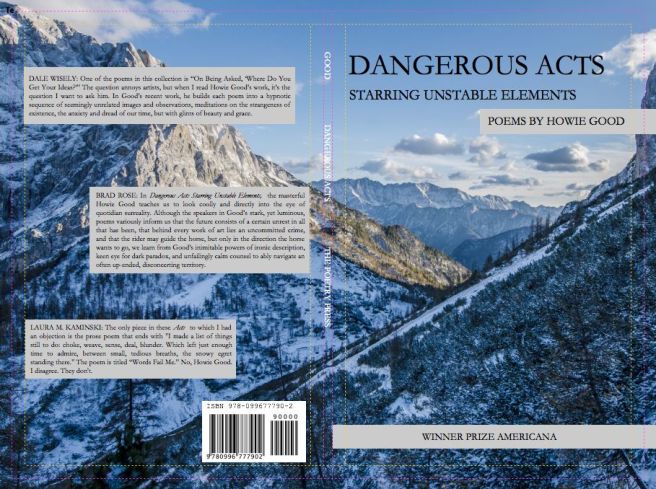
Howie Good’s “Dangerous Acts Starring Unstable Elements,” WINNER OF PRIZE AMERICANA

Howie Good


MockingHeart Review contributor, Howie Good’s Dangerous Acts Starring Unstable Elements contains poems that feature a penetrating analysis of contemporary life. It is published in paperback, available at Amazon and Barnes & Noble, and distributed through Ingram.


Praise for Dangerous Acts Starring Unstable Elements

DALE WISELY: One of the poems in this collection is “On Being Asked, ‘Where Do You Get Your Ideas?’” The question annoys artists, but when I read Howie Good’s work, it’s the question I want to ask him. In Good’s recent work, he builds each poem into a hypnotic sequence of seemingly unrelated images and observations, meditations on the strangeness of existence, the anxiety and dread of our time, but with glints of beauty and grace.


LAURA M. KAMINSKI: Dangerous Acts of Unstable Elements is a sequence of “selfies” on exhibit, one per page, in which the poet is relentlessly “photo-bombed” by reality, history, and myth. Nasty stains of every imaginable kind, the memorabilia of a witless age, constitute another section of the museum… (“And That’s What It’s All About”). But the poet gives us clues on how to cope with the nastiness: Point with your fading heart at the shadows puddled in the bottom of the ditch, where, nonetheless, something still glitters… (“Objects in This Mirror”). The only piece in these …Acts… to which I had an objection is the prose poem that ends with I made a list of things still to do: choke, weave, sense, deal, blunder. Which left just enough time to admire, between small, tedious breaths, the snowy egret standing there. The poem is titled “Words Fail Me.” No, Howie Good. I disagree. They don’t.


BRAD ROSE: In Dangerous Acts Starring Unstable Elements the masterful Howie Good teaches us to look coolly and directly into the eye of quotidian surreality. Although the speakers in Good’s stark, yet luminous, poems variously inform us that: the future consists of a certain unrest in all that has been, that behind every work of art lies an uncommitted crime, and that the rider may guide the horse, but only in the direction the horse wants to go, we learn from Good’s inimitable powers of ironic description, keen eye for dark paradox, and unfailingly calm counsel to ably navigate an often up-ended, disconcerting territory.  Indeed, with Good’s skillful guidance we learn not only to negotiate this weird and mysterious world, but to relish it.


ABOUT THE AUTHOR


Howie Good, a journalism professor at SUNY New Paltz, is the author of several poetry collections, including Beautiful Decay and The Cruel Radiance of What Is from Another

New Calligraphy, Fugitive Pieces from Right Hand Pointing Press, and Lovesick from The Poetry Press of Press Americana. He co-edits White Knuckle Press with Dale Wisely.


Contact information:
The Poetry Press of Press Americana

Americana: The Institute for the Study of American Popular Culture

7095-1240 Hollywood Boulevard

Hollywood, CA  90028

editor@americanpopularculture.com

http://www.americanpopularculture.com


Howie Good

Goodh51@gmail.com


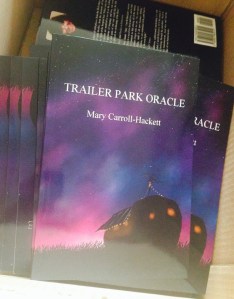
“Trailer Park Oracle” By Mary Carroll-Hackett

MockingHeart Review contributor Mary Carroll-Hackett’s new book, Trailer Park Oracle, has just been released. We couldn’t be happier for her, and for you, dear reader.

 12734059_10207886248101399_5166308052907969915_n
Praise for Trailer Park Oracle:

This is a book that peers from the edges of wild places: from the flickerings of a French film to the heady thrills of train trestles, from the doorways of long-abandoned houses to the quiet of the vigils at the hospital bed. With a voice both gentle and fierce, Carroll-Hackett’s poems are unafraid to see us as the aching creatures we are, to ask the hard questions of language and loss, not even flinching as they reveal the wonder and pain of our very world like the title poem’s Oracle, “calling them as they played, no cushioning of the blow.”

— Amy Tudor, author of A Book of Birds and Studies in Extinction

The needs that haunt our lives also haunt Mary Carroll-Hackett’s newest collection. In Trailer Park Oracle, there is a need for food and love, and to find the true self. But Carroll-Hackett also reminds us that among all of the shining things in this world, we might sometimes forget who we are. “So you repeat, some mantra you think you’re making, until it all just becomes shaking.” Through the rich narrative of this collection, we are reminded of the path back to ourselves, how “the seed knew, at last, its own light.”

–Julie Brooks Barbour, author of Small Chimes

These poems are anchored in love – stubborn, earth-bound, unrelenting love and the generosity that it engenders. And while Carroll-Hackett is NOT the oracle of the title, she is a diviner nevertheless, looking through the quotidian – bread & blankets, Ferris wheels & automotive transmissions, dead deer and starving bears – for clues to the mysterious nature of our human hearts.

–Doug Van Gundy

About Mary:

MockingHeart Review contributor, Mary Carroll-Hackett, earned the BA and MA from East Carolina University, and an MFA from Bennington College, Her work has appeared in numerous journals including Carolina Quarterly, Superstition Review, Drunken Boat and The Prose-Poem Project. She is the author of multiple books, including The Real Politics of Lipstick (Slipstream 2010), Animal Soul (Kattywompus Press, 2013),  If We Could Know Our Bones (A-Minor Press, 2014) and The Night I Heard Everything(FutureCycle Press, 2015). Another full-length collection, entitled A Little Blood, A Little Rain, is forthcoming from FutureCycle Press in 2016. She teaches at Longwood University and with the low-residency MFA faculty at West Virginia Wesleyan College. Mary is at work on a memoir.