
An interview with Bill Yarrow

MHR: The title The Vig of Love is taken from the title of a poem within the collection. Can you explain the title as you understand it and as it suggests the other poems?


BY: Vig, from “vigorish,” is the interest on a loanshark’s loan. Love is a debt, a loan you’ll never repay. The poems in this volume are about the different kinds of interest we owe on the impossible loan that is love. P.S. The Muse is also a loanshark.


MHR: In the title poem, the idea of risk is linked with love. Can you illuminate this idea as it pertains to many of the other poems that also delve into the nature of love in this light?


BY: The poem suggests love is a roulette bet. Sometimes we win. Sometimes we lose. But if we really love someone, we need to invest everything we have. We need to “put down all we’re worth.” The debt idea is made explicit in the poem “A Debt No Honest Man Can Pay” which begins the volume. The betting idea is made explicit in the poem “Wanna Bet?” which opens the last section of the book.


MHR: Do you see yourself as a contemporary absurdist? Do you see yourself as a truth seeker with a capital T? Does truth exist? If not, what responsibilities must a 21st century poet fulfill?


BY: I see myself as someone who writes poems. Nothing more.


Yes, specific truth exists, and general truths exist. Does Capital T Truth exist? No. Not for me.


The responsibility of a poet? To write well.


MHR: You have a couple of poems, that use bullet points to present statements of “truth” that are slant and wry.  What principles link these poems? What are their thematic unifiers?


BY: These “poems” (I’m not sure what they really are) consist of aphorisms or admonitions about love, pleasure, desire, passion, addiction, obsession. Read them with Samuel Johnson’s caveat: “In all pointed sentences, some degree of accuracy must be sacrificed to conciseness.” The title “Asbestos Candlestick” references the poem “The Exit Towards Fire.” The title “Sticky, Indifferent” comes from a phrase in “Liz@Phil,” a poem in Blasphemer


before ten years had passed
their loneliness had hardened

into indifferent sticky rapture
and permanent part-time jobs


MHR: As a poet rooted in the human condition, does man have a chance? And if so, does poetry?


BY: If we are human, we are “rooted in the human condition.” Poets are no different from anyone else. Everything has a chance—man, woman, humanity, poetry, goodness, beauty, ugliness, evil…. How much of a chance? That depends on the individual. And on the individual depends the world. As Emerson said, “An institution is the lengthened shadow of one man.” The future is the collective us.


MHR: Do you think your poems speak intimately to the reader or does the speaker hold the reader at a distance to instruct? Do you see yourself as a storyteller or a visionary/oracle?


BY: Every one of my poems intuits a speaker. Every speaker is different. None is me. That is, none is wholly me. My poems all tell stories. I don’t think any sane person ever sees himself or herself as an oracle.


MHR: There is an exacting sharpness in the language, and throughout we are treated to unexpected word collisions. Do you, as a poet, strive to make the unfamiliar familiar in your language?


BY: Thank you, Clare. I love that phrase “word collisions.” That’s an excellent phrase to describe a lot of what I do in my poems. In Pointed Sentences, my first book, there’s a poem called “Whiplash Marriage.” That title describes my approach and a lot of my work. I’m still smashing sound atoms, still officiating at whiplash marriages of non-consenting words.


I don’t strive to make the unfamiliar familiar exactly. I do solicit the unfamiliar and invite it into my poems. I strive to make the unfamiliar immediate and necessary, accessible and inevitable.


MHR: In the heart of the collection there seems to be a silent hope, which counters the difficulties of answerless questions in many of the poems. I think the balance is finely struck.  Do you sense a light in the darkness?


BY: I appreciate your comment about balance. Darkness is only darkness because there is light. Light is only light by virtue of there being darkness. As Blake said, “Opposition is true friendship.” No, there is no light in the darkness, but there is always the potential for light in the darkness. And vice versa.


MHR: I am immediately taken by the economy of words and clever turns of phrases, even though these poems embody so much more in their cumulative effect. Can you share with us some of your process in facing a blank page?


BY: Thank you, Clare, for that characterization of the poems in this book.

I seldom write on a literal blank page. Mostly, I write on a computer screen. I mention this because the size of a piece of paper sometimes affects or even dictates the length of a poem’s lines. If you are writing in a pocket notebook, you are likely writing in shorter lines than if you are writing in an oversized folio notebook. The reason is because, as you stare at the tiny notebook page, you are thinking in shorter lines, or thinking in longer lines if you are looking at a menu-sized blank journal.

The computer screen for me is neutral. It allows me to experiment with short lines, medium-sized lines, long lines, boxy poems, shaped poems, sprawling poems, prose poems, etc. I can immediately see what something looks like without having to rewrite it in a different form or shape. I can also save all the approaches to or versions of a poem.


My process? I play around. I play around with what things sound like, what things look like, how meaning changes with words in juxtaposition with each other, how meaning changes in a line ending or a line beginning. I’m a sculptor playing with the clay of words, sometimes piling bits on bits, sometimes scraping away dross to get at the essential form.


Sometimes, I begin with an event (“The Secret of Belief”) or a place (“Ajloun Castle”) or a person (John Dillinger / “Noir vs Noir”) or a memory (“The Ogontz Branch”). Sometimes, I begin with a word (“Babble”) or a phrase (“A Debt No Honest Man Can Pay”) or a text (“The Red Wheelbarrow” in “Carlos!”). Sometimes, I begin with a feeling (“Tierra del Fuego”) or a concept (“The Man Whose Wife Lived in His Neck”) or a pun (“Libby, Lottie, and Carlotta”).


Sometimes, the poem just emerges.


For me though, a beginning is just a beginning. I almost never end where I start.
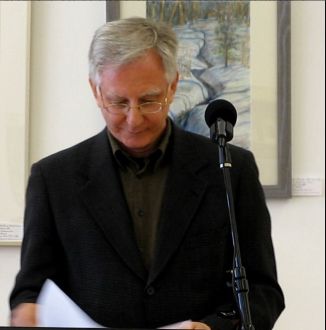


Bill Yarrow


Bill Yarrow, Professor of English at Joliet Junior College and an editor at the online journal Blue Fifth Review, is the author of The Vig of Love, Blasphemer, Pointed Sentences, and four chapbooks. His work also appears in the anthologies Aeolian Harp, Volume One; This is Poetry: Volume Two: The Midwest Poets; and Beginnings: How 14 Poets Got Their Start. He has been nominated eight times for a Pushcart Prize. More information about Bill can be found on his website: https://billyarrow.wordpress.com/
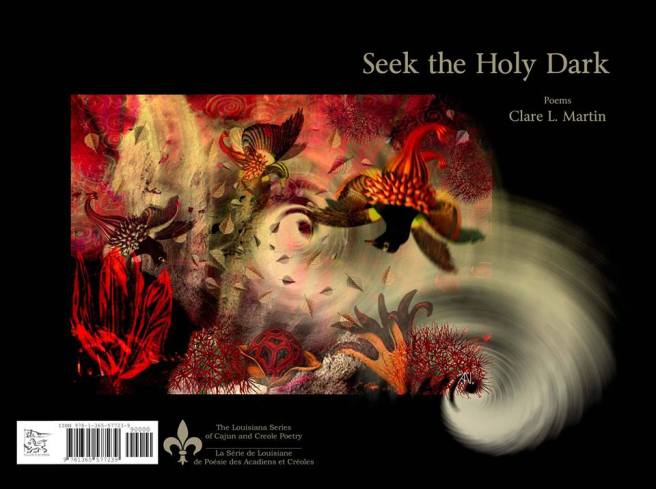
Clare L. Martin’s “Seek the Holy Dark”

cover-official
MockingHeart Review’s
 Editor, Clare L. Martin’s Seek the Holy Dark is the 2017 selection of the Louisiana Series of Cajun and Creole Poetry by Yellow Flag Press.

Seek the Holy Dark is now available for pre-order. Trade paperback, 66 pages, only $10. Pre-orders will ship in early February. To order click here.

Any new book of poems worth its salt must reinvent the intelligences of poetry: trope, word, image, argument, sentence, strophe, music. The poems in Clare Martin’s Seek the Holy Dark will keep. They are salt.

~Darrell Bourque, Former Louisiana Poet Laureate, author of Megan’s Guitar and Other Poems from Acadie and Where I Waited

From the holy dark of horror storms and freedom in the hand, to starving wolves and old women who live in woods, Clare Martin’s poetic imagery seeks in myth to locate depth of soul. She incants salvation “bone by bone” up from the shadows. Her writing has a beautiful fury, a hard questing and secret exultation that keep the reader poised and intoxicated. “Do you seek the heart too” the opening poem asks, and of course, we answer Yes and read breathlessly on. These poems “drop through this world/into dark awakening.” The strong-hearted will understand.

~Rachel Dacus, author of Gods of Water and Air

Seek the Holy Dark is a book of revelations in poems.  Clare L. Martin sees the richness and the poverty that are bedmates, proffers them as gifts, lays them at our feet.  Her poems suggest we join in the quest to be both humbled and exalted. Martin, who never looks away, fully understands the duality of nature, its light and darkness, exploring both in this lush and lyrical new collection.

~Susan Tepper, author of dear Petrov and The Merrill Diaries

Vol. 2, Issue 1 of MockingHeart Review

We welcome the new year with a brand new issue of MockingHeart Review. We’re completely enthralled with this issue and hope you will be too.  Please enjoy the issue and keep coming back to these pages as we will be presenting a new schedule of interviews and articles of interest to poets and readers in 2017.

With you in words,

The Editor


A note from the Editor

I want to share an opportunity with readers of MockingHeart Review. Recently I decided to use my expertise to develop a program of mentoring writers, and now I have expanded this program to address the needs of creatives in other disciplines. Please read on.

I give nearly 200% of myself during the eight weeks I work with mentees. I have numerous strategies to get creative juices flowing. If you find you need creative coaching, consulting on a creative writing project, editing insights, want to work one on one in your craft, or all of the above, consider engaging my services.Mentorships will be conducted through email, phone, and weekly consultations in person, if local, or via Skype link up to meet anyone across the miles.

The writing mentorships are structured courses that provide energetic and substantive relative-to-now literary conversations between the mentor and mentees. Great emphasis will be placed on craft and form.  The mentee should have expectations of fast-paced, rigorous writing and reflective, nurturing and honest feedback from a skilled and admired contemporary poet and publisher.

My second collection of poetry, Seek the Holy Dark, is forthcoming from Yellow Flag Press in 2017. My widely-acclaimed debut collection of poetry, Eating the Heart First, was published in 2012 by Press 53. My poetry has appeared in Avatar Review, Blue Fifth Review, Thrush Poetry Journal, Melusine, Poets and Artists, and Louisiana Literature, among others. I have been nominated for a Pushcart Prize, Dzanc Books’ Best of the Web, for Best New Poets and Sundress Publication’s Best of the Net. I am a lifelong resident of Louisiana and edit MockingHeart Review.

I am also a visual artist and offer mentorships for creatives of other disciplines that address breakthroughs in creativity, the creative process, creative problem solving and honoring the self as an artist in a hectic, sometimes dystopic world.

Other unique approaches to customized courses may be considered. Inquire with Clare at the email below or by phone. The number is listed below as well. I will always be honest with you if I feel your need would not match well with my expertise. But I will try my best to brainstorm on how it could.

Specific goals of the eight-week course will be decided upon in conversation prior to agreements being made to engage with me. It is encouraged that the course is structured as goal-oriented to produce visible and viable results.

The fee for the eight-week course is $250 US currency, (non-refundable due to course limits, serious inquiries only), payable through PayPal or by check. The spots are limited due to the very intimate work and close personal attention offered.  For more information, please email: clmpoetrymentor@gmail.com or call (337) 962-5886

A MHR Conversation: Robert Okaji

A MockingHeart Review Conversation with Robert Okaji, author of If Your Matter Could Reform (Dink Press, 2015)


MHR: Hi, Robert. I am glad we have this opportunity to talk to one another about your new chapbook, If Your Matter Could Reform.  I have a few questions which I hope will illuminate us.

RO: Thank you, Clare. I’m thrilled that you asked.


MHR: The first poem is “Wind” which introduces us to the ethereal voice that has a calming effect but also the authority and power to speak the deepest questions that you explore in the book. I love the wind motif that blows in and out of poems, like a wind.  What does the wind signify to you and what can we learn, formally, from paying attention to your use of it?

RO: We share our lives with the wind, yet are able to see it only through its effects. We can’t touch it, but we feel it. It has no voice, but we hear it through various vessels – leaves rattling in trees, wind chimes, discarded bottles, the vibration of it slamming against the house’s siding. Wind is a force, a carrier, and like poetry, like words, has the capacity to affect us in almost subliminal ways. There always seems to be an undercurrent, something pulling us towards the unsayable. There are no definitive answers. The wind is an open-ended question.


MHR: “Ashes” is breathtaking The last line made me gasp: “Scatter me in air I’ve never breathed.”  I won’t make assumptions about the emotional impetus of this poem, which is written in first person, but can you recall when composing the poem, the formation of that sentence, or was it something someone actually spoke?

RO: My mother had expressed a desire to be cremated, to have her ashes scattered in the Pacific, but later changed her mind. I asked myself how I’d like my earthly remains disposed of, and decided it would be most pleasing to have my ashes released somewhere I’ve never been, perhaps in the Jetstream (again, the wind motif), to move along strange paths, dispersing and mingling and covering more ground than ever possible in life. Hence the line.


MHR: “Rain Forest Bridge” is another lovely piece. Did you personally traverse such a bridge? I’m curious. If so, where? Is there something that is not in the poem that you would like to share about it?

RO: I have not crossed such a bridge. A poster, or wall hanging, served as the impetus of the poem. That, and the memory of a novel I read when I was about ten years old, in which a scene of the difficulties of walking across such a bridge for the first time apparently made a big impression on me. Such is the power of language!


MHR: All of the poems have a spirited, imaginative, reflective tone with language that approaches mystical writings. Please answer this questionnaire: In addition, or because you are a poet, would you also say you are a mystic, a philosopher, a metaphysician, or all/none of these?

RO: None of these. I’m primarily a reader, observer and inveterate questioner, and to a lesser extent, a thinker, whose influences and interests lean ever so slightly towards Eastern philosophy.


MHR: You have a longer-sequenced poem, “Earth’s Damp Mound” in the chapbook. In part III, “The Bowl of Flowering Shadows” the exploration of the unseen is most prominent. This statement contains the question which frames the whole work and give us its title: “So which, of all those you might recall, if your matter could reform and place you back into yourself, would you choose?”  Have you thought what your answer might be as a human being/poet?

RO: I’m much better at asking questions than answering them, but assuming that my matter would be reforming, and taking that experience into account, my reply would probably be framed with sensory elements – odors, sounds, colors, touch, tastes – rather than words, likely in the form of food (Asian/Southwest fusion) and music (Edgar Meyer on the bass).


MHR: Thank you for taking he time to talk with us about If Your Matter Could Reform, and best wishes from MockingHeart Review for many more words written by you.

 If Your Matter Could Reform is available from Dink Press: http://www.dinkpress.com/store/robertokaji

***

 okaji

Robert Okaji lives in Texas with his wife, two dogs and some books. He is the author of the chapbook If Your Matter Could Reform (Dink Press), and a micro-chapbook, You Break What Falls (Origami Poems Project). His work has appeared in Boston Review, Prime Number Magazine, Mockingheart Review, two Silver Birch Press anthologies, Hermeneutic Chaos, Kindle Magazine, Clade Song, Eclectica and elsewhere. Visit his blog, O at the Edges, at http://robertokaji.com/.