
An interview with Bill Yarrow

MHR: The title The Vig of Love is taken from the title of a poem within the collection. Can you explain the title as you understand it and as it suggests the other poems?


BY: Vig, from “vigorish,” is the interest on a loanshark’s loan. Love is a debt, a loan you’ll never repay. The poems in this volume are about the different kinds of interest we owe on the impossible loan that is love. P.S. The Muse is also a loanshark.


MHR: In the title poem, the idea of risk is linked with love. Can you illuminate this idea as it pertains to many of the other poems that also delve into the nature of love in this light?


BY: The poem suggests love is a roulette bet. Sometimes we win. Sometimes we lose. But if we really love someone, we need to invest everything we have. We need to “put down all we’re worth.” The debt idea is made explicit in the poem “A Debt No Honest Man Can Pay” which begins the volume. The betting idea is made explicit in the poem “Wanna Bet?” which opens the last section of the book.


MHR: Do you see yourself as a contemporary absurdist? Do you see yourself as a truth seeker with a capital T? Does truth exist? If not, what responsibilities must a 21st century poet fulfill?


BY: I see myself as someone who writes poems. Nothing more.


Yes, specific truth exists, and general truths exist. Does Capital T Truth exist? No. Not for me.


The responsibility of a poet? To write well.


MHR: You have a couple of poems, that use bullet points to present statements of “truth” that are slant and wry.  What principles link these poems? What are their thematic unifiers?


BY: These “poems” (I’m not sure what they really are) consist of aphorisms or admonitions about love, pleasure, desire, passion, addiction, obsession. Read them with Samuel Johnson’s caveat: “In all pointed sentences, some degree of accuracy must be sacrificed to conciseness.” The title “Asbestos Candlestick” references the poem “The Exit Towards Fire.” The title “Sticky, Indifferent” comes from a phrase in “Liz@Phil,” a poem in Blasphemer


before ten years had passed
their loneliness had hardened

into indifferent sticky rapture
and permanent part-time jobs


MHR: As a poet rooted in the human condition, does man have a chance? And if so, does poetry?


BY: If we are human, we are “rooted in the human condition.” Poets are no different from anyone else. Everything has a chance—man, woman, humanity, poetry, goodness, beauty, ugliness, evil…. How much of a chance? That depends on the individual. And on the individual depends the world. As Emerson said, “An institution is the lengthened shadow of one man.” The future is the collective us.


MHR: Do you think your poems speak intimately to the reader or does the speaker hold the reader at a distance to instruct? Do you see yourself as a storyteller or a visionary/oracle?


BY: Every one of my poems intuits a speaker. Every speaker is different. None is me. That is, none is wholly me. My poems all tell stories. I don’t think any sane person ever sees himself or herself as an oracle.


MHR: There is an exacting sharpness in the language, and throughout we are treated to unexpected word collisions. Do you, as a poet, strive to make the unfamiliar familiar in your language?


BY: Thank you, Clare. I love that phrase “word collisions.” That’s an excellent phrase to describe a lot of what I do in my poems. In Pointed Sentences, my first book, there’s a poem called “Whiplash Marriage.” That title describes my approach and a lot of my work. I’m still smashing sound atoms, still officiating at whiplash marriages of non-consenting words.


I don’t strive to make the unfamiliar familiar exactly. I do solicit the unfamiliar and invite it into my poems. I strive to make the unfamiliar immediate and necessary, accessible and inevitable.


MHR: In the heart of the collection there seems to be a silent hope, which counters the difficulties of answerless questions in many of the poems. I think the balance is finely struck.  Do you sense a light in the darkness?


BY: I appreciate your comment about balance. Darkness is only darkness because there is light. Light is only light by virtue of there being darkness. As Blake said, “Opposition is true friendship.” No, there is no light in the darkness, but there is always the potential for light in the darkness. And vice versa.


MHR: I am immediately taken by the economy of words and clever turns of phrases, even though these poems embody so much more in their cumulative effect. Can you share with us some of your process in facing a blank page?


BY: Thank you, Clare, for that characterization of the poems in this book.

I seldom write on a literal blank page. Mostly, I write on a computer screen. I mention this because the size of a piece of paper sometimes affects or even dictates the length of a poem’s lines. If you are writing in a pocket notebook, you are likely writing in shorter lines than if you are writing in an oversized folio notebook. The reason is because, as you stare at the tiny notebook page, you are thinking in shorter lines, or thinking in longer lines if you are looking at a menu-sized blank journal.

The computer screen for me is neutral. It allows me to experiment with short lines, medium-sized lines, long lines, boxy poems, shaped poems, sprawling poems, prose poems, etc. I can immediately see what something looks like without having to rewrite it in a different form or shape. I can also save all the approaches to or versions of a poem.


My process? I play around. I play around with what things sound like, what things look like, how meaning changes with words in juxtaposition with each other, how meaning changes in a line ending or a line beginning. I’m a sculptor playing with the clay of words, sometimes piling bits on bits, sometimes scraping away dross to get at the essential form.


Sometimes, I begin with an event (“The Secret of Belief”) or a place (“Ajloun Castle”) or a person (John Dillinger / “Noir vs Noir”) or a memory (“The Ogontz Branch”). Sometimes, I begin with a word (“Babble”) or a phrase (“A Debt No Honest Man Can Pay”) or a text (“The Red Wheelbarrow” in “Carlos!”). Sometimes, I begin with a feeling (“Tierra del Fuego”) or a concept (“The Man Whose Wife Lived in His Neck”) or a pun (“Libby, Lottie, and Carlotta”).


Sometimes, the poem just emerges.


For me though, a beginning is just a beginning. I almost never end where I start.
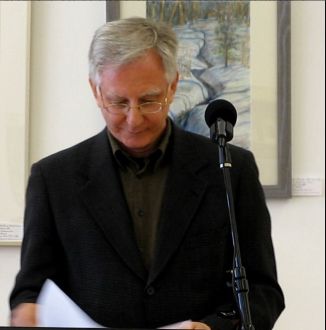


Bill Yarrow


Bill Yarrow, Professor of English at Joliet Junior College and an editor at the online journal Blue Fifth Review, is the author of The Vig of Love, Blasphemer, Pointed Sentences, and four chapbooks. His work also appears in the anthologies Aeolian Harp, Volume One; This is Poetry: Volume Two: The Midwest Poets; and Beginnings: How 14 Poets Got Their Start. He has been nominated eight times for a Pushcart Prize. More information about Bill can be found on his website: https://billyarrow.wordpress.com/
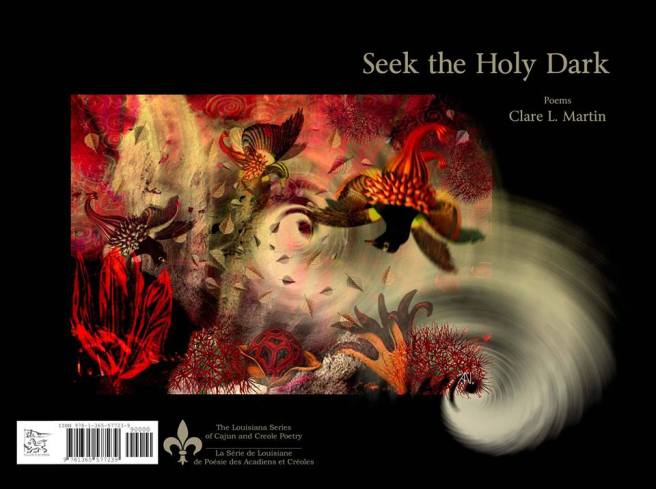
Clare L. Martin’s “Seek the Holy Dark”

cover-official
MockingHeart Review’s
 Editor, Clare L. Martin’s Seek the Holy Dark is the 2017 selection of the Louisiana Series of Cajun and Creole Poetry by Yellow Flag Press.

Seek the Holy Dark is now available for pre-order. Trade paperback, 66 pages, only $10. Pre-orders will ship in early February. To order click here.

Any new book of poems worth its salt must reinvent the intelligences of poetry: trope, word, image, argument, sentence, strophe, music. The poems in Clare Martin’s Seek the Holy Dark will keep. They are salt.

~Darrell Bourque, Former Louisiana Poet Laureate, author of Megan’s Guitar and Other Poems from Acadie and Where I Waited

From the holy dark of horror storms and freedom in the hand, to starving wolves and old women who live in woods, Clare Martin’s poetic imagery seeks in myth to locate depth of soul. She incants salvation “bone by bone” up from the shadows. Her writing has a beautiful fury, a hard questing and secret exultation that keep the reader poised and intoxicated. “Do you seek the heart too” the opening poem asks, and of course, we answer Yes and read breathlessly on. These poems “drop through this world/into dark awakening.” The strong-hearted will understand.

~Rachel Dacus, author of Gods of Water and Air

Seek the Holy Dark is a book of revelations in poems.  Clare L. Martin sees the richness and the poverty that are bedmates, proffers them as gifts, lays them at our feet.  Her poems suggest we join in the quest to be both humbled and exalted. Martin, who never looks away, fully understands the duality of nature, its light and darkness, exploring both in this lush and lyrical new collection.

~Susan Tepper, author of dear Petrov and The Merrill Diaries

A note from the Editor

I want to share an opportunity with readers of MockingHeart Review. Recently I decided to use my expertise to develop a program of mentoring writers, and now I have expanded this program to address the needs of creatives in other disciplines. Please read on.

I give nearly 200% of myself during the eight weeks I work with mentees. I have numerous strategies to get creative juices flowing. If you find you need creative coaching, consulting on a creative writing project, editing insights, want to work one on one in your craft, or all of the above, consider engaging my services.Mentorships will be conducted through email, phone, and weekly consultations in person, if local, or via Skype link up to meet anyone across the miles.

The writing mentorships are structured courses that provide energetic and substantive relative-to-now literary conversations between the mentor and mentees. Great emphasis will be placed on craft and form.  The mentee should have expectations of fast-paced, rigorous writing and reflective, nurturing and honest feedback from a skilled and admired contemporary poet and publisher.

My second collection of poetry, Seek the Holy Dark, is forthcoming from Yellow Flag Press in 2017. My widely-acclaimed debut collection of poetry, Eating the Heart First, was published in 2012 by Press 53. My poetry has appeared in Avatar Review, Blue Fifth Review, Thrush Poetry Journal, Melusine, Poets and Artists, and Louisiana Literature, among others. I have been nominated for a Pushcart Prize, Dzanc Books’ Best of the Web, for Best New Poets and Sundress Publication’s Best of the Net. I am a lifelong resident of Louisiana and edit MockingHeart Review.

I am also a visual artist and offer mentorships for creatives of other disciplines that address breakthroughs in creativity, the creative process, creative problem solving and honoring the self as an artist in a hectic, sometimes dystopic world.

Other unique approaches to customized courses may be considered. Inquire with Clare at the email below or by phone. The number is listed below as well. I will always be honest with you if I feel your need would not match well with my expertise. But I will try my best to brainstorm on how it could.

Specific goals of the eight-week course will be decided upon in conversation prior to agreements being made to engage with me. It is encouraged that the course is structured as goal-oriented to produce visible and viable results.

The fee for the eight-week course is $250 US currency, (non-refundable due to course limits, serious inquiries only), payable through PayPal or by check. The spots are limited due to the very intimate work and close personal attention offered.  For more information, please email: clmpoetrymentor@gmail.com or call (337) 962-5886

Susan Tepper talks with us about ‘dear Petrov’

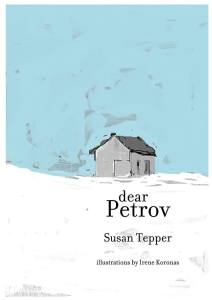
MockingHeart Review’s Founding Publisher and Editor, Clare L. Martin, connected with MHR contributor, Susan Tepper, for a one-on-one interview about Susan’s stunning new book, ‘dear Petrov.’ 

We hope you enjoy the interview and are intrigued enough to get your hands on Susan’s new book. We highly recommend it.

 1913881_940688549357324_4740966744800379870_n


CLM:  Hi, Susan.  Thank you for agreeing to do this interview for MockingHeart Review’s “Beats” blog. My first question begins with the beginning. I want to ask you about inspiration. When did you first encounter the voice of the woman in ‘dear Petrov’ and begin writing her?

ST: Clare, the female narrator appeared to me on a June day in 2015.  I sat down blank at the screen and she popped herself in.  I often feel we writers are doing the work of the ‘so-called dead poet’s society’—in that we are channels for writers who have passed on to wherever they go.  I don’t say this lightly.  It’s my belief system that Mozart, for example, wasn’t born a genius but carried his musical abilities over from an earlier lifetime, then expanded on them, plus received help from other great musicians who’d passed away.  This makes total sense to me.  It’s how art keeps growing and evolving.  This passing along of knowledge, or coming to the artist and banging on the walls until the voice is heard by the one currently doing the work.  There is nothing worse to the artist than to think when they are gone it’s all been for naught.

CLM: What is it that led you to set this in 19th century Russia? Were you interested in the historical period? Can you enlighten us a bit about your initial process and any research you undertook?

ST: Before I took up the writing life, I was an actress from the age of seventeen.  I had the great opportunity of acting in several Chekhov plays, and I think I’ve read them all.  Plus, the Chekhov stories.  The time period in which he wrote his plays and stories, and the Russian settings, probably lodged into my unconscious mind.  When a method actor takes on a role, the point is to inhabit both character and setting and their history.  So it was undoubtedly brewing for some time, and when my female protagonist in ‘dear Petrov’ said (wrote) the name of her lover, in the very first piece, it came out as Petrov.  If I were to really dig deep, into my own recesses, I would say that Russia came out due to my experiencing one of the coldest, darkest, most forlorn winters imaginable, just prior to the writing of this book.

CLM: There is so much that can be said about a woman oppressed in this book. Can you speak to the different kinds of oppression that this character experiences?

ST: My female protagonist (who isn’t named in the book) is one of the loneliest women I’ve ever encountered.  She lives in a remote part of Russia, and the man she loves is a career soldier who mostly isn’t around.  That wasn’t particularly unusual for those times.  Career soldiers fought in their homeland as well as in wars of other lands.  Often they were gone for years.  When Petrov did make an appearance in the book, it was generally lacking in what my narrator needed and desperately longed for.  I truly don’t know why she put up with him.  Or, as many reviewers have suggested, whether Petrov actually did exist, or was a conjured up creation to fill her emptiness.  If you are a believer in solipsism, then this would be the ultimate solipsism—a glimpse into all that is missing, except you.

CLM: The woman is not voiceless. We are reading her words. They might have slipped away if you had not written them. Can you tell us how it channeled through you? Does it still come to you now?

ST: Yes, it was most definitely channeled to me.  It could come to me again if I sat down again with her.  But I won’t.  Her story is finished.  She decided.  She dictated and I typed.

CLM: Are there aspects of her voice that you identify with?

ST: Einstein was a believer in parallel universes.  I subscribe to that same theory.  Perhaps while I am living as Susan Tepper, I am also this woman living in late 19th Century Russia during a time of war.  Perhaps she broke through to me.  It wouldn’t be the first time.  In another of my books ‘What May Have Been’ I wrote the voice of the artist Jackson Pollock.  People were stunned that Pollock’s voice came through a woman.  I was also stunned.  It just happened.  Because it was effortless, the way the woman came effortless in ‘dear Petrov.’  It required no effort on my part.  So, yes, I identify with all that she says and feels.

CLM: The woman’s horse features in the book.  What, for you, does the horse signify?

ST: Well, first of all, I grew up around horses, cows, and other animals.  Their spirituality always amazes me.  Animals are leagues ahead of humans when it comes to loyalty and unconditional devotion.  So after the first story, it became clear to me that my female protagonist was living without a male companion.  The second story, Floods, was a breakthrough.  And that’s when the horse presents.  Her love for the horse and what he symbolizes for her was quite heartbreaking to me.  He is her sole companion about 99 % of the time.  Without her horse, well, I can’t imagine.

CLM: There is a sentence in the book that reads, “My time here must be more than lines.”  Is this the perilous predicament of the writer?

ST: Yes, I believe it is.

CLM: I loved this book and will return to it often. There is a consistent flow. What was the length of time that it took to write, up to publication? Did you write the pieces fluidly and then break them, or were they always short prose pieces?

ST: When I start something, I generally write every day.  Unless I’m travelling, then I never write.  So I started the Petrov stories in June and wrote one or more a day.  I did revise them.  Some have been previously published in journals and zines, and when I realized I had a book length of them, I did go through and revise here and there.  For me, revision is usually some descriptive lines added.  The structure of each piece, and what it was about, came out in the first drafts.  They were always in the short form that you see now.   So, all in all, the book took me about three months to complete.  Thank you, Clare, for loving the book!

CLM: Do you work on several writing projects at once, or work singularly on one work at a time?

ST: It depends.  I often work on long fiction (full length novels) and cap the writing off with a poem.  It isn’t an intentional choice, just happenstance.  If I’m in a mad writing whirl, I’ll often go to other work that isn’t, in my opinion, ready to be presented to the world.  And I’ll work on that.  I think doing alternating repertory theatre (a different play a night) makes it easy for me to switch from different characters and themes.  It’s the best thing in life, this writing we do.  It shapes my life into a big bowl of happy.

CLM: I think of the phrase “a body besieged.” Could this be an apt description of the female narrator? Could this be the soldier’s predicament, too? Or, all of ours?

ST: That’s an interesting concept but I don’t have the answer.

CLM: Can the woman define herself apart from Petrov? Is this what she is trying to do; delineate herself in the world, apart from his dominance?  Will she become one with nature, which features prominently in the book?

ST: I don’t think she can define herself apart from Petrov.  He is some underlying condition in her.  I think he’s her fevers and chills.  Or a fantasy perhaps to keep herself sane.  I don’t know exactly why he’s so relevant to her.

CLM: For a long time, some of the only writing women committed to paper was in letters, diaries, and personal journals. How does this feature in ‘dear Petrov’? Is the page freedom, as this kind of writing seems to suggest?

ST: These pieces in ‘dear Petrov’ were never meant to be letters.  They are musings, at best, or a glimpse into this woman’s psyche.  I don’t think freedom exists anywhere in any form.  Freedom is an illusion.  My book ‘dear Petrov’ is illusory, as well.  It doesn’t ask anything from the reader.  It doesn’t take anything either.  It just exists the way nature does.  It either calls to you or it doesn’t.

CLM: So much of this book conjures mystery. Can you speak to the importance of mystery in literary writings, how it impacts you as a writer and reader, even if the book is not classified as a mystery?

ST: Clare, I think fiction and poetry must contain some surreal elements if it is to be really good work.  The best poets know this by instinct.  And surreal elements suggest mystery, because anything in art that’s surreal is not realism.  It’s a distorted realism, a heightened realism.  That’s what I’m drawn to as both a fiction writer and poet.  I want my eggs scrambled, not discernible on the plate.

CLM: We kindly thank you for taking the time to answer our questions. And congratulations on a fantastic work of art.

ST: Clare, talking with you here has been an act of pure joy.  Thank you for having me, and for your loving support of ‘dear Petrov.’

***


 About MockingHeart Review Contributor Susan Tepper

Susan Tepper has been a writer for twenty years.  ‘dear Petrov’ (Pure Slush Books, Australia, 2016) is her sixth published book.  Stories, poems, essays and interviews by Tepper have been published worldwide.  Her column ‘Let’s Talk’ at Black Heart Magazine runs monthly.  FIZZ her reading series at KGB Bar, NYC, has been sporadically ongoing for eight years.  www.susantepper.com