GOLDFINCHES
I hope you can see goldfinches from where you are, smallish birds
dressed
in their snappy blazers—today
they nose among pots
of miniature sunflowers I grow
on my balcony—the black seeds
punctuate
a calligraphy etched
on their lemony wings. Goldfinches, or cardinals,
or a trumpeter
swan, of course you see
nothing, you who placed a gun in your mouth
and removed
your self
from the world; so I keep my eyes peeled
for any form of amazement, if only in the shape
of a blossom, or a bird.
THE AMULET
In the summer of your 58th year
you step out the back door,
and before you can turn
the key
in its lock,
a dragonfly,
entirely
the green
of lime sherbet,
from its jeweled eyes
to the stickpin body
and filigreed
wings, a dragonfly bumps
once, twice, three
times against your arm,
and then drills itself toward
the center
of your chest, like the whisper
of a dagger.
Are you sure you’re awake?
It’s an hour
past dawn, the beginning
of the day, and you’ve never
seen anything
like it on these narrow steps,
an amulet;
a ceremonial
knife,
the dragonfly hovers
at the height
of the tangle of tv cable and electrical
wires, above the cracked
asphalt and sparkling bits
of glass.
I guess
it must be true
that the gods
are always calling.
PHOTOGRAPH OF MY FATHER
And his blue Ford convertible: The trees
are bare, but does this mean winter
or the first breath of spring?
What’s apparent is his dark-suited
Sunday best, and the cigarette,
a white line matching
the handkerchief triangle in his right
breast pocket, and the flat
snow field of his dress shirt.
You will note the polish
on his shoes and the deep ocean gleam,
the body of the car, he liked
the burnish and reflection he could give
to things, his right hand
scissored on that cigarette, his left hand
resting on the door
of the car. I can’t tell you who took
this photo, but anyone
can see that the door is open,
the convertible
roof down, the powder-blue Interior
exposed
to the wind. In a moment he’ll step in
and drive away.
Leaving is what
he did best in those days.
Poet’s Statement:
In “Goldfinches” I put together two things that are often on my mind—the loss of my sister to suicide, (years ago now, but still a constant sadness) and the delight I feel in my neighborhood in Chicago whenever I see goldfinches, a bird that has become more common in our urban environment now that people are planting more sunflowers and other native prairie plants. It may be trite, but I feel that I owe the world my delighted attention, most especially because my sister and others who are lost to me can no longer enjoy these mundane and swiftly passing moments of beauty.
“The Amulet” is one of those poems that is pretty much pure reportage. I had to leave for work early, with a long day ahead of me, and this bright green dragonfly stopped me in my tracks as I was rushing down my back steps. The poem remains nearly unchanged from a notebook entry I wrote down a day or two later. I keep a notebook where I try to document happenings in my life before they fade away and are forgotten. I sort of think of this poem as “having my Mary Oliver moment.”
“Photograph of My Father” is also reportage, or at least description. I found the snapshot described in the poem in a box of my father’s things that I brought to my house after he had to move to an assisted living facility. I didn’t open the box until a year or two after he died, and I had not remembered seeing the photo before. It was amazing to see him youthful and vital again, like a young Frank Sinatra. But the happiness of seeing him well-groomed and in front of a car that he loved was tempered by my memory of him in those days—often leaving the house, sometimes for days at a time, and coming home drunk late at night. I hasten to add that he stopped drinking many years before he passed, and I have plenty of great memories of my dad. The poem (I hope) mixes the pleasure of seeing him young with the complicated memories from that time.
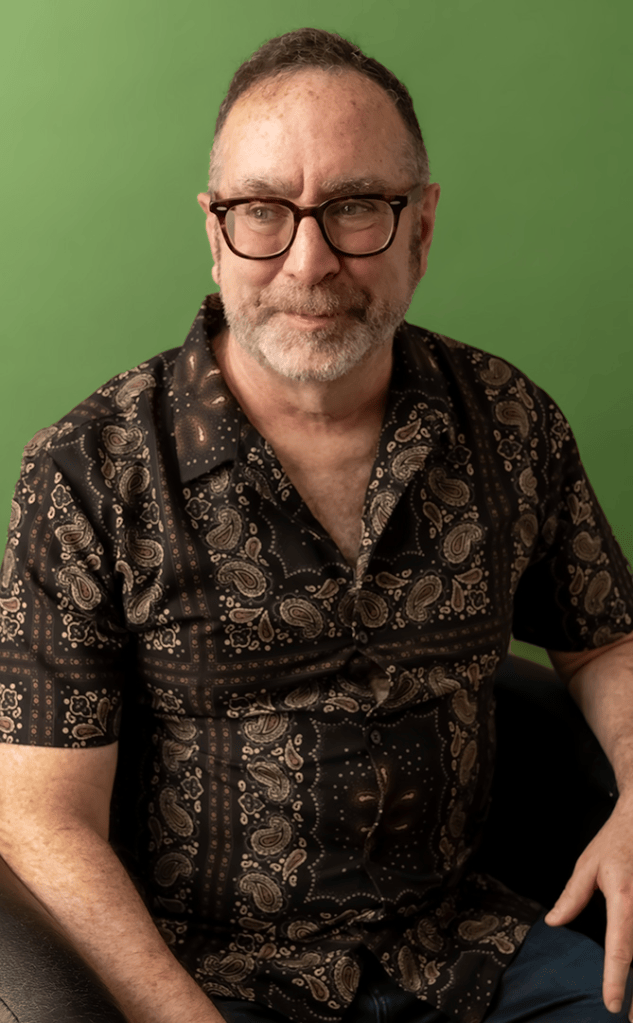
Robert McDonald’s first book of poems, “A Streetlight That’s Been Told It Used to Be the Moon,” is coming from Roadside Press in 2026. His work has appeared in Does It Have Pockets, Painted Bride Quarterly, The Marrow, Gyroscope, Tabula Rasa Review, and The Madrid Review, among others. He lives with his husband in Chicago.

