Volume 1, Issue 3

Dear MockingHeart Review Readers,


Thank you for visiting the pages of MockingHeart Review. We are glad to have your company. We welcome you to enjoy the fall issue just released September 1st.  With this issue, we celebrate our first anniversary. We are thrilled to mark this occasion with more beauty gathered here from poets near and far. So, please pour yourself a beverage and get comfortable. Take in the words of souls who have achieved mastery in the art form of poetry and have chosen to live their lives bringing their gifts to humanity for the betterment of humanity. To showcase such poets is our mission here at MockingHeart Review.

“Flood” by J Bruce Fuller

9781930454408

I cannot recommend this chapbook highly enough. Poem by poem, MockingHeart Review contributor, Dr. J Bruce Fuller, takes us into the depths of the human soul unearthed by floodwaters of two historic events: The 1927 Flood and Katrina. We feel the losses as our own, and they are. J Bruce puts us in the maw of the rivers and in the coursing waters to be carried away unless we cling to his language, which is deeply grounded, rooted in a passion for Louisiana in all her mystery and mystique. In light of the 2016 Louisiana Flood, I encourage you to purchase a copy of this perfect volume while it is still available. It will haunt you like no other book on the subject.

~ Clare L. Martin, Editor, MockingHeart Review

To purchase Flood follow this link:  http://www.spdbooks.org/Products/9781930454408/flood.aspx

More about Flood

“In this sensual and deeply informed collection, J Bruce Fuller gives us two floods in the lower Mississippi River, almost a century apart. Describing the 1927 flood, the poems speak of men who stand on the levee to report the water’s rise. Some are forced to knit arms and legs, a kind of human dam, and are washed away. In 2005, the levees are strong, and people ‘in the shadow of the levee’ feel smug and safe. They see meteorologists on CNN, and they watch the floodwater and destruction follow Katrina. Beyond those differences, the poems make clear, in concrete language, that there was the same betrayal, superstition, family ties, same indiscriminate death, wealth and its small protections, poverty and its vulnerability. These poems do not elegize life on the river a century ago as a time that will never return, or evoke New Orleans as it used to be before the storm. These poems know, as the river knows, that time is not linear, it is cyclical. The river will be there when our brief stories are gone. The flood can come again, when it will. As one of the men on the levee says, and repeats like a line in a blues song: ‘What water will come, will come.'”—Ava Leavell Haymon

A milestone

Our Fall Issue, which will be released September 1, 2016, will coincide with the one year anniversary of the founding of the magazine! With this celebration of one wonderful year, we have undertaken a new site design. We hope it is to your liking. We hope to bring a fresh look year after year to go along with the freshest, juiciest poetry of all seasons. We have so many to thank: all of our contributors and readers of course. We have had so much interest and positive conversations about our venture! Thank you all. Our Fall Issue will be presented in just a few weeks. Please visit the website often to read its treasures.


The Editor

8410036009090G

Lafayette’s Juvenile Detainees Learn Spoken Word Poetry

Wonderful work being done by Alex “PoeticSoul” Johnson in my hometown of Lafayette, Louisiana. I hope the good word spreads of the work she is doing in our community. If her work inspires you, maybe you can be inspired to work in your community to address this vulnerable population in our society. Contact info for Alex and informational links are below.

Clare L. Martin
MockingHeart Review
________________________________


Lafayette’s Juvenile Detainees Learn Spoken Word Poetry


Every Friday, students at the Lafayette Parish Juvenile Detention Center in Lafayette, Louisiana gather to study, practice and perform spoken word poetry.

Spoken word students at the JDC face enormous psychological, social, and financial difficulties. Four out of every five residents in Louisiana’s Juvenile Detention Centers are children of color. (Children of color make up 46.5% of Louisiana’s children.) Incarcerated juveniles are disproportionately from impoverished families, and represent our most at-risk and underprivileged children. 24.5% of detained juveniles will experience recidivism within three years.

Teaching detained children is particularly difficult, with a restrictive environment and a continuously changing group of children. But spoken word artist Alex “PoeticSoul” Johnson gives these children the tools and opportunity to educate and express themselves artistically. Each week, she teaches a rotating group of kids, from one to ten at a time, ages 11-17, how to convert their fears and frustrations into positive, life-affirming art.

Most recently, a total of thirty students created the group poem wrote, edited, and directed the poem “Eyes of the Sun,” which PoeticSoul then composed and recorded as a spoken-word-and-music video. In April 2016, she presented the video at the Split This Rock Poetry Festival in Washington, DC, where a national audience of poets and activists learned of our children’s efforts, returning videos and notes of encouragement. Through experiences like this, these children get to see the quality of their own hard work. They have the chance to learn that, by transforming their anger and frustration into something positive, they can produce wonderful fruit.

Alex “PoeticSoul” Johnson is a UL Student Senior Marketing Major and the founder and manager of Lyrically Inclined, an organization that hosts spoken word events in Lafayette, at places like the Acadiana Center for the Arts, the Festival of Words, Cité des Arts, and Black Café. She encourages the people of Lafayette and Acadiana to take this opportunity to encourage our incarcerated children, and help guide them onto a more creative and fulfilling path. She is available for interviews at poeticsoul337@gmail.com or (713) 933-4448.

CONTACT: Alex “PoeticSoul” Johnson

poeticsoul337@gmail.com

(713) 933-4448

For more information:  Official YouTube performance of “Eyes of the Sun:” https://youtu.be/KF-x-qGSeUg

Poeticsoul reading and discussing “Eyes of the Sun” at Crescent City Books: https://youtu.be/-u0Kdmv66Co

Lyrically Inclined on Facebook: http://www.facebook.com/lyricallyinclined337/

Lyrically Inclined on Instagram: http://www.instagram.com/poeticsoul337/

Split This Rock Poetry Festival: http://www.splitthisrock.org/programs/festival/2016-poetry-festival/panel-roundtable-discussions/#Roundtables

Response to “Eyes of the Sun” from Split This Rock Board Secetary Susan Scheid: https://www.facebook.com/PoeticSoul337/videos/vb.47903650/10101865578642720/


Sources for incarceration rates:  Juvenlie detainees, by race: http://datacenter.kidscount.org/data/tables/8391-youth-residing-in-juvenile-detention-correctional-and-or-residential-facilities-by-race-and-hispanic-origin?loc=20&loct=2#detailed/2/20/false/36/4038,4411,1461,1462,1460,4157,1353/16996,17598

General population statistics: http://datacenter.kidscount.org/data/tables/3852-child-population-by-race?loc=20&loct=2#detailed/2/any/false/868,867,133,38,35/13,3,141,142,2,1/7997,7998

Recidivism statistics: http://ojj.la.gov/ojj/files/file/Demographics/Recidivism%20Website%20July%202013.pdf

aLive Poetry 24/7 – 365

Please enjoy our second issue, the Spring/Summer Issue of MockingHeart Review.  We are completely thrilled with its contents. Truly stunning poetry from across the globe that reflects great diversity in poetic styles and in cultural influences. Feel free to comment on the poets’ pages. We encourage our contributors to interact with you!


Peace to you in all your joyful poetic adventures!

Construction Zone

Hello, MockingHeart Review friends and readers. Work is underway on the Spring/Summer Issue which may be released a little early because your dear Editor is feeling National Poetry Month. Stay tuned.

Also, we will be bringing you more author interviews, guest blogs, and timely news on new publications of our contributors’ works. We are poetry central and love sharing words and words about words with you.


HAPPY NATIONAL POETRY MONTH


Using Fabulist Elements to Write the Difficult

   by MockingHeart Review contributor, Stacey Balkun*


I’ve become obsessed with reading and writing fabulism. My poem in Issue 1 of MockingHeart Review, “The Domestic Mermaid Fosters Her Crush,” turns a woman feeling trapped in her household into a mermaid: a creature truly out of place in her setting. She obsesses over sushi delivery because it’s something familiar. Her homesickness and emotional distress turn tangible and her search for intimacy, heartbreaking. All of this is amplified by the fact that she has fins! She has a secret; she’s so out of place. She literally can’t survive this situation.


I didn’t learn the term fabulism until recently. Fabulism doesn’t mean just that mermaids are fabulous but that the work is fabulist: relying on fables, moving in and out of this world and another. Magical elements are placed in a real world. When these magical elements are working, the reader doesn’t question how a mermaid housewife can even get to the door to answer it; they accept that a mermaid called in an order for delivery and focus instead on the human elements that are reflected through fantasy.


Moving into another world is how I learned to discover my own self: of another world. I was adopted as a baby, but I still don’t know many details about my birthmother or her circumstances. Inspired by Anna Journey’s “Fox-girl Before Birth,” I wrote an origin-poem called “Rabbit-girl Before Birth” (eventually changed to “Jackalope-Girl”). One imitation led to another, and imagining my baby self as a mythical creature allowed me to consider my birthmother as one too, so she became the beautiful, misguided, mythical Antler-Girl. She was no longer a blank space in my memory, and because I wasn’t imagining her in realistic terms, I could write without any reservations about making assumptions or being untruthful.


This is what fabulism allows. Realism, the domestic, mundane or even uncomfortable spaces can find new life with an element of myth, magic, or fantasy. For me as a writer and reader, fabulism is strongest when it exists in small doses. I like the real world slightly augmented: an antler, a pair of wings, a mermaid tail. Using only an element or two creates tension rather than fantasy. It allows the reader to feel grounded while still understanding great emotional resonance. Fabulist elements can resonate as metaphors, most often for feelings of not belonging.


Putting something alien into our world allows it to take on a new meaning, which is how poets have always used metaphor: Robert Burns’s love like a “red red rose” was surprising and new when he wrote it, but it’s certainly become a cliché now. Building a magical real world opens up new possibility for imagery and metaphor, which is crucial for telling it new.


It also allows us, as writers, an escape from difficult subjects. We can avoid it, or we can pretend things aren’t how they are. Fabulist elements allow a different kind of pretend by letting a writer look her subject in the eye, but from a distance that is comfortable enough to let the writing happen. I admire poets who can write difficult poems from that raw, painful space. I wish I could, but I tense up and turn away. Incorporating fabulist elements lets me get there in my own way. In Jackalope-Girl’s world, all of the discomfort I felt and all of my childhood feeling out of place became the world’s inability (or perhaps unwillingness) to encompass the strange—not her inability to fulfill normalcy. I don’t want to write poems that fulfill expectations of normalcy, either. I want jackalopes and mermaids and other fabulist elements that allow the poem to hop in and out of weirdness while staying grounded in the world; keeping it domestic, yes, but far from normal.


*Read Stacey Balkun’s poetry in Volume 1, Issue 1–here.

Balkun (1)


Stacey Balkun is the author of two chapbooks, Jackalope-Girl Learns to Speak (dancing girl 2016) & Lost City Museum (ELJ Publications 2016). She received her MFA from Fresno State and her work has appeared or will appear in Gargoyle, Muzzle, THRUSH, Bodega, and others. A 2015 Hambidge Fellow, Stacey served as Artist-in-Residence at the Great Smoky Mountains National Park in 2013. She is a contributing writer for The California Journal of Women Writers and a teaching artist at The Poetry Barn.


Submissions are closed, but there’s more…

OLYMPUS DIGITAL CAMERA
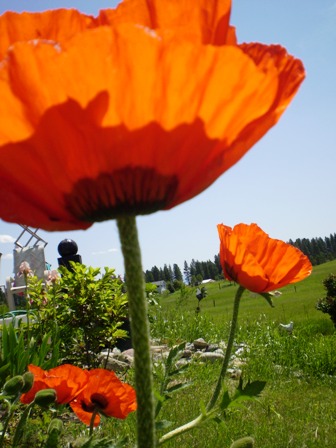
POPPIES, MONTANA (CLARE L. MARTIN)

Work is underway to bring you a very fresh Spring/Summer Issue on May 1st, 2016. The next open reading period will be JUL. 1 TO AUG. 1. THANK YOU FOR YOUR SUPPORT AND INTEREST in MockingHeart Review. 

                                          ~The Editor