A MHR Conversation: Robert Okaji

A MockingHeart Review Conversation with Robert Okaji, author of If Your Matter Could Reform (Dink Press, 2015)


MHR: Hi, Robert. I am glad we have this opportunity to talk to one another about your new chapbook, If Your Matter Could Reform.  I have a few questions which I hope will illuminate us.

RO: Thank you, Clare. I’m thrilled that you asked.


MHR: The first poem is “Wind” which introduces us to the ethereal voice that has a calming effect but also the authority and power to speak the deepest questions that you explore in the book. I love the wind motif that blows in and out of poems, like a wind.  What does the wind signify to you and what can we learn, formally, from paying attention to your use of it?

RO: We share our lives with the wind, yet are able to see it only through its effects. We can’t touch it, but we feel it. It has no voice, but we hear it through various vessels – leaves rattling in trees, wind chimes, discarded bottles, the vibration of it slamming against the house’s siding. Wind is a force, a carrier, and like poetry, like words, has the capacity to affect us in almost subliminal ways. There always seems to be an undercurrent, something pulling us towards the unsayable. There are no definitive answers. The wind is an open-ended question.


MHR: “Ashes” is breathtaking The last line made me gasp: “Scatter me in air I’ve never breathed.”  I won’t make assumptions about the emotional impetus of this poem, which is written in first person, but can you recall when composing the poem, the formation of that sentence, or was it something someone actually spoke?

RO: My mother had expressed a desire to be cremated, to have her ashes scattered in the Pacific, but later changed her mind. I asked myself how I’d like my earthly remains disposed of, and decided it would be most pleasing to have my ashes released somewhere I’ve never been, perhaps in the Jetstream (again, the wind motif), to move along strange paths, dispersing and mingling and covering more ground than ever possible in life. Hence the line.


MHR: “Rain Forest Bridge” is another lovely piece. Did you personally traverse such a bridge? I’m curious. If so, where? Is there something that is not in the poem that you would like to share about it?

RO: I have not crossed such a bridge. A poster, or wall hanging, served as the impetus of the poem. That, and the memory of a novel I read when I was about ten years old, in which a scene of the difficulties of walking across such a bridge for the first time apparently made a big impression on me. Such is the power of language!


MHR: All of the poems have a spirited, imaginative, reflective tone with language that approaches mystical writings. Please answer this questionnaire: In addition, or because you are a poet, would you also say you are a mystic, a philosopher, a metaphysician, or all/none of these?

RO: None of these. I’m primarily a reader, observer and inveterate questioner, and to a lesser extent, a thinker, whose influences and interests lean ever so slightly towards Eastern philosophy.


MHR: You have a longer-sequenced poem, “Earth’s Damp Mound” in the chapbook. In part III, “The Bowl of Flowering Shadows” the exploration of the unseen is most prominent. This statement contains the question which frames the whole work and give us its title: “So which, of all those you might recall, if your matter could reform and place you back into yourself, would you choose?”  Have you thought what your answer might be as a human being/poet?

RO: I’m much better at asking questions than answering them, but assuming that my matter would be reforming, and taking that experience into account, my reply would probably be framed with sensory elements – odors, sounds, colors, touch, tastes – rather than words, likely in the form of food (Asian/Southwest fusion) and music (Edgar Meyer on the bass).


MHR: Thank you for taking he time to talk with us about If Your Matter Could Reform, and best wishes from MockingHeart Review for many more words written by you.

 If Your Matter Could Reform is available from Dink Press: http://www.dinkpress.com/store/robertokaji

***

 okaji

Robert Okaji lives in Texas with his wife, two dogs and some books. He is the author of the chapbook If Your Matter Could Reform (Dink Press), and a micro-chapbook, You Break What Falls (Origami Poems Project). His work has appeared in Boston Review, Prime Number Magazine, Mockingheart Review, two Silver Birch Press anthologies, Hermeneutic Chaos, Kindle Magazine, Clade Song, Eclectica and elsewhere. Visit his blog, O at the Edges, at http://robertokaji.com/.


Happenings with Tim Suermondt

OLYMPUS DIGITAL CAMERA

MockingHeart Review contributor, Tim Suermondt, has poems in the latest issue of Ploughshares and The Southeast Review. His next full-length collection of poems ELECTION NIGHT AND THE FIVE SATINS will be out shortly from Glass Lyre Press. He continues to write book reviews for Cervena Barva Press and does poem evaluations for Bellevue Literary Review.  Great news, Tim!


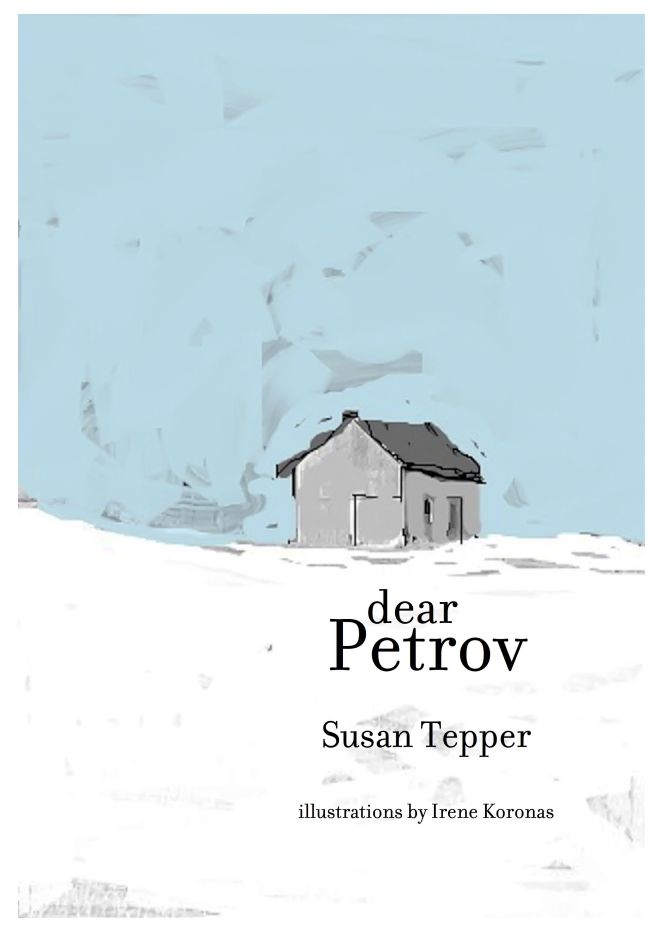
Susan Tepper talks with us about ‘dear Petrov’

MockingHeart Review’s Founding Publisher and Editor, Clare L. Martin, connected with MHR contributor, Susan Tepper, for a one-on-one interview about Susan’s stunning new book, ‘dear Petrov.’ 

We hope you enjoy the interview and are intrigued enough to get your hands on Susan’s new book. We highly recommend it.
 1913881_940688549357324_4740966744800379870_n


CLM:  Hi, Susan.  Thank you for agreeing to do this interview for MockingHeart Review’s “Beats” blog. My first question begins with the beginning. I want to ask you about inspiration. When did you first encounter the voice of the woman in ‘dear Petrov’ and begin writing her?

ST: Clare, the female narrator appeared to me on a June day in 2015.  I sat down blank at the screen and she popped herself in.  I often feel we writers are doing the work of the ‘so-called dead poet’s society’—in that we are channels for writers who have passed on to wherever they go.  I don’t say this lightly.  It’s my belief system that Mozart, for example, wasn’t born a genius but carried his musical abilities over from an earlier lifetime, then expanded on them, plus received help from other great musicians who’d passed away.  This makes total sense to me.  It’s how art keeps growing and evolving.  This passing along of knowledge, or coming to the artist and banging on the walls until the voice is heard by the one currently doing the work.  There is nothing worse to the artist than to think when they are gone it’s all been for naught.

CLM: What is it that led you to set this in 19th century Russia? Were you interested in the historical period? Can you enlighten us a bit about your initial process and any research you undertook?

ST: Before I took up the writing life, I was an actress from the age of seventeen.  I had the great opportunity of acting in several Chekhov plays, and I think I’ve read them all.  Plus, the Chekhov stories.  The time period in which he wrote his plays and stories, and the Russian settings, probably lodged into my unconscious mind.  When a method actor takes on a role, the point is to inhabit both character and setting and their history.  So it was undoubtedly brewing for some time, and when my female protagonist in ‘dear Petrov’ said (wrote) the name of her lover, in the very first piece, it came out as Petrov.  If I were to really dig deep, into my own recesses, I would say that Russia came out due to my experiencing one of the coldest, darkest, most forlorn winters imaginable, just prior to the writing of this book.

CLM: There is so much that can be said about a woman oppressed in this book. Can you speak to the different kinds of oppression that this character experiences?

ST: My female protagonist (who isn’t named in the book) is one of the loneliest women I’ve ever encountered.  She lives in a remote part of Russia, and the man she loves is a career soldier who mostly isn’t around.  That wasn’t particularly unusual for those times.  Career soldiers fought in their homeland as well as in wars of other lands.  Often they were gone for years.  When Petrov did make an appearance in the book, it was generally lacking in what my narrator needed and desperately longed for.  I truly don’t know why she put up with him.  Or, as many reviewers have suggested, whether Petrov actually did exist, or was a conjured up creation to fill her emptiness.  If you are a believer in solipsism, then this would be the ultimate solipsism—a glimpse into all that is missing, except you.

CLM: The woman is not voiceless. We are reading her words. They might have slipped away if you had not written them. Can you tell us how it channeled through you? Does it still come to you now?

ST: Yes, it was most definitely channeled to me.  It could come to me again if I sat down again with her.  But I won’t.  Her story is finished.  She decided.  She dictated and I typed.

CLM: Are there aspects of her voice that you identify with?

ST: Einstein was a believer in parallel universes.  I subscribe to that same theory.  Perhaps while I am living as Susan Tepper, I am also this woman living in late 19th Century Russia during a time of war.  Perhaps she broke through to me.  It wouldn’t be the first time.  In another of my books ‘What May Have Been’ I wrote the voice of the artist Jackson Pollock.  People were stunned that Pollock’s voice came through a woman.  I was also stunned.  It just happened.  Because it was effortless, the way the woman came effortless in ‘dear Petrov.’  It required no effort on my part.  So, yes, I identify with all that she says and feels.

CLM: The woman’s horse features in the book.  What, for you, does the horse signify?

ST: Well, first of all, I grew up around horses, cows, and other animals.  Their spirituality always amazes me.  Animals are leagues ahead of humans when it comes to loyalty and unconditional devotion.  So after the first story, it became clear to me that my female protagonist was living without a male companion.  The second story, Floods, was a breakthrough.  And that’s when the horse presents.  Her love for the horse and what he symbolizes for her was quite heartbreaking to me.  He is her sole companion about 99 % of the time.  Without her horse, well, I can’t imagine.

CLM: There is a sentence in the book that reads, “My time here must be more than lines.”  Is this the perilous predicament of the writer?

ST: Yes, I believe it is.

CLM: I loved this book and will return to it often. There is a consistent flow. What was the length of time that it took to write, up to publication? Did you write the pieces fluidly and then break them, or were they always short prose pieces?

ST: When I start something, I generally write every day.  Unless I’m travelling, then I never write.  So I started the Petrov stories in June and wrote one or more a day.  I did revise them.  Some have been previously published in journals and zines, and when I realized I had a book length of them, I did go through and revise here and there.  For me, revision is usually some descriptive lines added.  The structure of each piece, and what it was about, came out in the first drafts.  They were always in the short form that you see now.   So, all in all, the book took me about three months to complete.  Thank you, Clare, for loving the book!

CLM: Do you work on several writing projects at once, or work singularly on one work at a time?

ST: It depends.  I often work on long fiction (full length novels) and cap the writing off with a poem.  It isn’t an intentional choice, just happenstance.  If I’m in a mad writing whirl, I’ll often go to other work that isn’t, in my opinion, ready to be presented to the world.  And I’ll work on that.  I think doing alternating repertory theatre (a different play a night) makes it easy for me to switch from different characters and themes.  It’s the best thing in life, this writing we do.  It shapes my life into a big bowl of happy.

CLM: I think of the phrase “a body besieged.” Could this be an apt description of the female narrator? Could this be the soldier’s predicament, too? Or, all of ours?

ST: That’s an interesting concept but I don’t have the answer.

CLM: Can the woman define herself apart from Petrov? Is this what she is trying to do; delineate herself in the world, apart from his dominance?  Will she become one with nature, which features prominently in the book?

ST: I don’t think she can define herself apart from Petrov.  He is some underlying condition in her.  I think he’s her fevers and chills.  Or a fantasy perhaps to keep herself sane.  I don’t know exactly why he’s so relevant to her.

CLM: For a long time, some of the only writing women committed to paper was in letters, diaries, and personal journals. How does this feature in ‘dear Petrov’? Is the page freedom, as this kind of writing seems to suggest?

ST: These pieces in ‘dear Petrov’ were never meant to be letters.  They are musings, at best, or a glimpse into this woman’s psyche.  I don’t think freedom exists anywhere in any form.  Freedom is an illusion.  My book ‘dear Petrov’ is illusory, as well.  It doesn’t ask anything from the reader.  It doesn’t take anything either.  It just exists the way nature does.  It either calls to you or it doesn’t.

CLM: So much of this book conjures mystery. Can you speak to the importance of mystery in literary writings, how it impacts you as a writer and reader, even if the book is not classified as a mystery?

ST: Clare, I think fiction and poetry must contain some surreal elements if it is to be really good work.  The best poets know this by instinct.  And surreal elements suggest mystery, because anything in art that’s surreal is not realism.  It’s a distorted realism, a heightened realism.  That’s what I’m drawn to as both a fiction writer and poet.  I want my eggs scrambled, not discernible on the plate.

CLM: We kindly thank you for taking the time to answer our questions. And congratulations on a fantastic work of art.

ST: Clare, talking with you here has been an act of pure joy.  Thank you for having me, and for your loving support of ‘dear Petrov.’

***


 About MockingHeart Review Contributor Susan Tepper

Susan Tepper has been a writer for twenty years.  ‘dear Petrov’ (Pure Slush Books, Australia, 2016) is her sixth published book.  Stories, poems, essays and interviews by Tepper have been published worldwide.  Her column ‘Let’s Talk’ at Black Heart Magazine runs monthly.  FIZZ her reading series at KGB Bar, NYC, has been sporadically ongoing for eight years.  www.susantepper.com

Progress update

We are at capacity for the Spring/Summer Issue of MockingHeart Review. Poems sent during this open reading period (currently open until April 1, 12:00 a.m. CST) will be considered for the Fall issue.


Excited to have been flooded with fine, fine poetry from across the planet. Thank you for understanding.

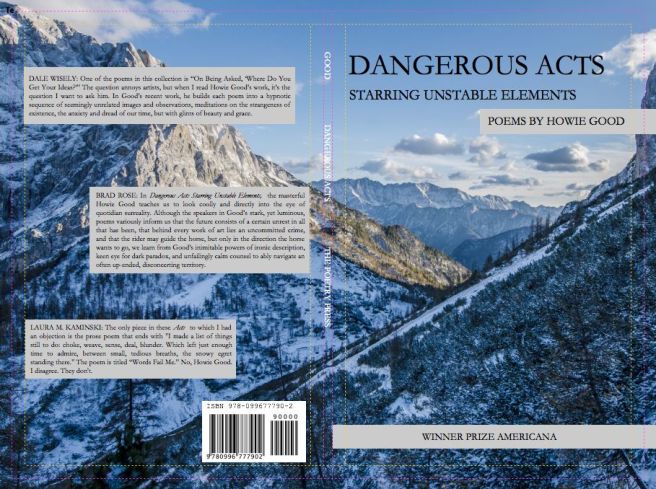
Howie Good’s “Dangerous Acts Starring Unstable Elements,” WINNER OF PRIZE AMERICANA

Howie Good


MockingHeart Review contributor, Howie Good’s Dangerous Acts Starring Unstable Elements contains poems that feature a penetrating analysis of contemporary life. It is published in paperback, available at Amazon and Barnes & Noble, and distributed through Ingram.


Praise for Dangerous Acts Starring Unstable Elements

DALE WISELY: One of the poems in this collection is “On Being Asked, ‘Where Do You Get Your Ideas?’” The question annoys artists, but when I read Howie Good’s work, it’s the question I want to ask him. In Good’s recent work, he builds each poem into a hypnotic sequence of seemingly unrelated images and observations, meditations on the strangeness of existence, the anxiety and dread of our time, but with glints of beauty and grace.


LAURA M. KAMINSKI: Dangerous Acts of Unstable Elements is a sequence of “selfies” on exhibit, one per page, in which the poet is relentlessly “photo-bombed” by reality, history, and myth. Nasty stains of every imaginable kind, the memorabilia of a witless age, constitute another section of the museum… (“And That’s What It’s All About”). But the poet gives us clues on how to cope with the nastiness: Point with your fading heart at the shadows puddled in the bottom of the ditch, where, nonetheless, something still glitters… (“Objects in This Mirror”). The only piece in these …Acts… to which I had an objection is the prose poem that ends with I made a list of things still to do: choke, weave, sense, deal, blunder. Which left just enough time to admire, between small, tedious breaths, the snowy egret standing there. The poem is titled “Words Fail Me.” No, Howie Good. I disagree. They don’t.


BRAD ROSE: In Dangerous Acts Starring Unstable Elements the masterful Howie Good teaches us to look coolly and directly into the eye of quotidian surreality. Although the speakers in Good’s stark, yet luminous, poems variously inform us that: the future consists of a certain unrest in all that has been, that behind every work of art lies an uncommitted crime, and that the rider may guide the horse, but only in the direction the horse wants to go, we learn from Good’s inimitable powers of ironic description, keen eye for dark paradox, and unfailingly calm counsel to ably navigate an often up-ended, disconcerting territory.  Indeed, with Good’s skillful guidance we learn not only to negotiate this weird and mysterious world, but to relish it.


ABOUT THE AUTHOR


Howie Good, a journalism professor at SUNY New Paltz, is the author of several poetry collections, including Beautiful Decay and The Cruel Radiance of What Is from Another

New Calligraphy, Fugitive Pieces from Right Hand Pointing Press, and Lovesick from The Poetry Press of Press Americana. He co-edits White Knuckle Press with Dale Wisely.


Contact information:
The Poetry Press of Press Americana

Americana: The Institute for the Study of American Popular Culture

7095-1240 Hollywood Boulevard

Hollywood, CA  90028

editor@americanpopularculture.com

http://www.americanpopularculture.com


Howie Good

Goodh51@gmail.com


“Trailer Park Oracle” By Mary Carroll-Hackett

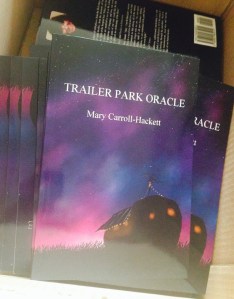
MockingHeart Review contributor Mary Carroll-Hackett’s new book, Trailer Park Oracle, has just been released. We couldn’t be happier for her, and for you, dear reader.

 12734059_10207886248101399_5166308052907969915_n
Praise for Trailer Park Oracle:

This is a book that peers from the edges of wild places: from the flickerings of a French film to the heady thrills of train trestles, from the doorways of long-abandoned houses to the quiet of the vigils at the hospital bed. With a voice both gentle and fierce, Carroll-Hackett’s poems are unafraid to see us as the aching creatures we are, to ask the hard questions of language and loss, not even flinching as they reveal the wonder and pain of our very world like the title poem’s Oracle, “calling them as they played, no cushioning of the blow.”

— Amy Tudor, author of A Book of Birds and Studies in Extinction

The needs that haunt our lives also haunt Mary Carroll-Hackett’s newest collection. In Trailer Park Oracle, there is a need for food and love, and to find the true self. But Carroll-Hackett also reminds us that among all of the shining things in this world, we might sometimes forget who we are. “So you repeat, some mantra you think you’re making, until it all just becomes shaking.” Through the rich narrative of this collection, we are reminded of the path back to ourselves, how “the seed knew, at last, its own light.”

–Julie Brooks Barbour, author of Small Chimes

These poems are anchored in love – stubborn, earth-bound, unrelenting love and the generosity that it engenders. And while Carroll-Hackett is NOT the oracle of the title, she is a diviner nevertheless, looking through the quotidian – bread & blankets, Ferris wheels & automotive transmissions, dead deer and starving bears – for clues to the mysterious nature of our human hearts.

–Doug Van Gundy

About Mary:

MockingHeart Review contributor, Mary Carroll-Hackett, earned the BA and MA from East Carolina University, and an MFA from Bennington College, Her work has appeared in numerous journals including Carolina Quarterly, Superstition Review, Drunken Boat and The Prose-Poem Project. She is the author of multiple books, including The Real Politics of Lipstick (Slipstream 2010), Animal Soul (Kattywompus Press, 2013),  If We Could Know Our Bones (A-Minor Press, 2014) and The Night I Heard Everything(FutureCycle Press, 2015). Another full-length collection, entitled A Little Blood, A Little Rain, is forthcoming from FutureCycle Press in 2016. She teaches at Longwood University and with the low-residency MFA faculty at West Virginia Wesleyan College. Mary is at work on a memoir.

Two weeks until submissions re-open

We are so grateful to our contributors and readers who have helped us skyrocket in our first issue that was released on January 1st. We’ve had readers from over 30 countries visit the site, connecting to the authors within. We hope you have enjoyed the selections we have made. We are getting ready to do it again.

We are looking forward to March 1st, when submissions re-open.  Please read our guidelines https://mockingheartreview.com/submission-guidelines/ and prepare your submissions accordingly.  If you want to surmise a bit about our taste in poetry, read our first issue. Our taste is quite refined, and yet, broad– The quality of the work is our most defined requirement.


An interview with MHR contributor, Susan Tepper

MockingHeart Review contributor and friend, Susan Tepper, is interviewed by T. L. Sherwood at Literary Orphans.

Here’s the link: http://literaryorphans.org/ttl/t-l-sherwood-interviews-susan-tepper/


Susan’s book “Dear Petrov” will be released Feb. 2nd by Pure Slush Press. Congrats, Susan!

dear Petrov cover (1)