An Interview with Tyler Sheldon


MHR:
Thank you for agreeing to do this interview for MockingHeart Review, Tyler. I really enjoyed First Breaths of Arrival, your chapbook from Oil Hill Press. Can you tell me a bit about the genesis of the chapbook? How long was it in the making? How did you envision the collection?

TS: Hi, Clare and MockingHeart, thanks for having me! My chapbook began as a desire to collect my Plains poetry–my poems of place–into a cohesive unit with a large underlying narrative. I wanted to tell the story of my upbringing, and of my observations of Kansas–how it shapes the way I think, and my interactions with nature and individuals. Since around 2012, I’d been drafting and revising poetry along these lines, trying to be respectful of my place in the Midwest and my heritage there. I’d grown up around Kansas poets (my father, William Sheldon, is one, and so were several family friends), and so when I began in poetry it was both the most natural and most urgent direction to take.

I started First Breaths of Arrival while working on my Master of Arts in English at Emporia State University, and I knew I wanted it to be a shorter collection. It grew in tandem with my MA thesis, which focused on Kansas poetry (specifically that of William Stafford, Harley Elliott, and Steven Hind). As my collection grew more cohesive, I approached Oil Hill Press; editor John Jenkinson worked with me as I pared it down, replacing some poems with ones that fit better. Oil Hill released the chapbook to the world in May 2016, the day I graduated with my MA.

MHR: Landscape, place, specifically Kansas is featured strongly throughout and your treatment of it is done with a deft hand.  The poems tell us much about Kansas in what is said of it, in descriptions. Can you speak to the poem, “In Kansas,” and tell us a few things that are not said? Maybe lines or images you cut out of the poem? There are also “ghosts” and ancient people in this landscape. Can you speak to this how you drew them in as a poet?

TS: I’m glad to know the treatment of landscape and place is done well! Poems throughout First Breaths deal with the state and its landscape in various ways–“For Kansas Poets” links the landscape to its residents in behavior and thought. “In Kansas” deals specifically with unique Kansas imagery: the Hutchinson salt mine, for instance, is now a museum housing such artifacts as the costumes from Star Wars and Gone With the Wind. As you mention, there are several unsaid pieces of that poem, including Kansas’s influence on poetry at large, and how I learned to be (somewhat) adult while living there.

The line “throw clove cigarette butts into the street” speaks to a pastime I shared with my wife, whom I met in Kansas and was then dating. We’d go for late-night cruises in my Nissan or her Ford coupe, smoking clove cigars and sometimes stopping for take-out. More than that, though, this line hints at possibility; the disparate activities in the poem are examples, suggesting that in Kansas, much more opportunity for exploring oneself can be had. In a way, then, the whole poem is about unsaid truths or opportunities.

The “ancient people” of the Kansas landscape are integral–I’ve long been fascinated with Kansas history and its people. My father collects Native American and Paleolithic artifacts on the Arkansas River as a sort of compelled hobby, so I had early exposure to the evidence people leave of their lives. Former Kansas poet laureate Denise Low discusses her own Native ancestry in several collections of her work, and her explorations fed my fascination with the ghosts of our state. Addressing these through writing felt like both the best fit and a way to contribute to what is very much a place-centered poetic tradition.

MHR: Throughout the collection. there are the interrelationships of men and boys, specifically the speaker of the poems and his elders–father, grandfather. The relationships are drawn very realistically and finely. The notes of coming into manhood are struck purely. I especially loved the poem “Mountains.” Not that it matters to the poem’s truth, but how much of your family history plays into this poem’s narrative? It’s quite colorful. Also, can you speak to the metaphor of “mountains” as you employ it in this poem?

TS: Thanks for noticing the relationship focus! It’s there on several levels–for example, “My Father Teaches Me to Shave” is a true account, and if altered at all from factual happening it would be by my fallible memory rather than any poetic license. My father and I wrote “For Kansas Poets” together over a period of about two weeks, comparing drafts and working them gradually together into their current sonnet form.

“Mountains” is interesting in this regard, as during the time when my grandfather was telling me stories of his father, my own dad was there in the Suburban with us as we drove into the Rockies. So, in a way, four generations of the Sheldon family were present for Grandpa Bob’s stories. His father Hubert Sheldon really was a surprisingly good boxer, a baseball player, and a liquor store owner. And with him, people really did know not to mess around.

In the poem, itself, those mountains work on a surface level–they provide scenery, and context for the conversation that’s the backbone of the poem. They’re also metaphors, I suppose–as we went deeper into the mountains, up to Grandpa’s mountain cabin, we went deeper into family history, with its complexities and intrigue. Another trip to the Rockies is probably due at some point, as I’m sure I still have a lot to learn.

MHR: I think we really covered a great number of interesting points about your eloquent collection. Thank you! The only follow-up question I would ask is if you would speak to the metaphor of a mountain as it relates to a man as a figure/a mountain in a boy’s or young man’s life.

TS: I suppose that mountains have a certain place in boyhood, and probably manhood, as structures that inspire awe. To say, “I’ve been up there,” and certainly to say “I’ve been up there with my father and grandfather” is a point of pride for me–those visits to the mountains gained status as a tradition over time and influenced me. The mountains became a symbol of proving oneself in nature, though in my situation they were a sort of middle-landscape. I wasn’t roughing it, out there in a tent hunting for sustenance, but I did learn a bit from my grandfather about building powder rifles, and how to shoot properly, throw knives with accuracy, cut firewood, tend a stove, and so on.

I’d say those activities are inextricable from being in the Rockies, at least for me–I’m being a bit glib, but you can’t necessarily practice target shooting when you’re in a suburban neighborhood, for example. So yes, mountains have a place in my boyhood and very young adulthood, and one that I remain proud of.

~

Interested folks can buy Tyler’s chapbook, First Breaths of Arrival, by emailing him at tyrsheldon@gmail.com, or by emailing John Jenkinson (Oil Hill Press publisher) at jjenkinson@butlercc.edu.
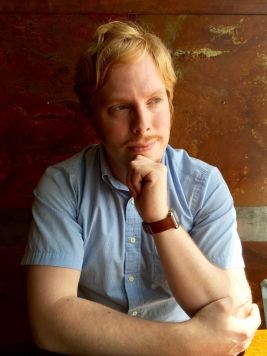
 

Tyler Sheldon


Tyler Sheldon is an MFA candidate in Poetry at McNeese State University. He earned his MA in English at Emporia State University, where he taught Composition and received the 2016 Charles E. Walton Essay Award. Sheldon’s poetry has been nominated for the Pushcart Prize and has appeared in journals throughout the US and in Canada, such as Quiddity International Literary Journal, The Dos Passos Review, Coal City Review, The Prairie Journal, and others. His chapbook First Breaths of Arrival is from Oil Hill Press (May 2016).
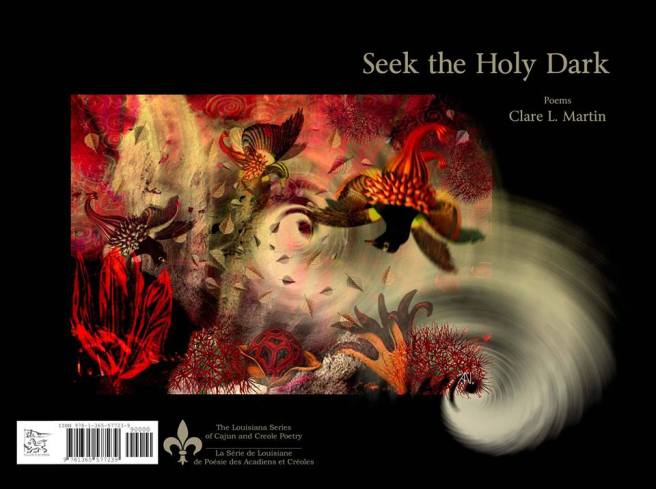
Clare L. Martin’s “Seek the Holy Dark”

cover-official
MockingHeart Review’s
 Editor, Clare L. Martin’s Seek the Holy Dark is the 2017 selection of the Louisiana Series of Cajun and Creole Poetry by Yellow Flag Press.

Seek the Holy Dark is now available for pre-order. Trade paperback, 66 pages, only $10. Pre-orders will ship in early February. To order click here.

Any new book of poems worth its salt must reinvent the intelligences of poetry: trope, word, image, argument, sentence, strophe, music. The poems in Clare Martin’s Seek the Holy Dark will keep. They are salt.

~Darrell Bourque, Former Louisiana Poet Laureate, author of Megan’s Guitar and Other Poems from Acadie and Where I Waited

From the holy dark of horror storms and freedom in the hand, to starving wolves and old women who live in woods, Clare Martin’s poetic imagery seeks in myth to locate depth of soul. She incants salvation “bone by bone” up from the shadows. Her writing has a beautiful fury, a hard questing and secret exultation that keep the reader poised and intoxicated. “Do you seek the heart too” the opening poem asks, and of course, we answer Yes and read breathlessly on. These poems “drop through this world/into dark awakening.” The strong-hearted will understand.

~Rachel Dacus, author of Gods of Water and Air

Seek the Holy Dark is a book of revelations in poems.  Clare L. Martin sees the richness and the poverty that are bedmates, proffers them as gifts, lays them at our feet.  Her poems suggest we join in the quest to be both humbled and exalted. Martin, who never looks away, fully understands the duality of nature, its light and darkness, exploring both in this lush and lyrical new collection.

~Susan Tepper, author of dear Petrov and The Merrill Diaries

Vol. 2, Issue 1 of MockingHeart Review

We welcome the new year with a brand new issue of MockingHeart Review. We’re completely enthralled with this issue and hope you will be too.  Please enjoy the issue and keep coming back to these pages as we will be presenting a new schedule of interviews and articles of interest to poets and readers in 2017.

With you in words,

The Editor


A note from the Editor

I want to share an opportunity with readers of MockingHeart Review. Recently I decided to use my expertise to develop a program of mentoring writers, and now I have expanded this program to address the needs of creatives in other disciplines. Please read on.

I give nearly 200% of myself during the eight weeks I work with mentees. I have numerous strategies to get creative juices flowing. If you find you need creative coaching, consulting on a creative writing project, editing insights, want to work one on one in your craft, or all of the above, consider engaging my services.Mentorships will be conducted through email, phone, and weekly consultations in person, if local, or via Skype link up to meet anyone across the miles.

The writing mentorships are structured courses that provide energetic and substantive relative-to-now literary conversations between the mentor and mentees. Great emphasis will be placed on craft and form.  The mentee should have expectations of fast-paced, rigorous writing and reflective, nurturing and honest feedback from a skilled and admired contemporary poet and publisher.

My second collection of poetry, Seek the Holy Dark, is forthcoming from Yellow Flag Press in 2017. My widely-acclaimed debut collection of poetry, Eating the Heart First, was published in 2012 by Press 53. My poetry has appeared in Avatar Review, Blue Fifth Review, Thrush Poetry Journal, Melusine, Poets and Artists, and Louisiana Literature, among others. I have been nominated for a Pushcart Prize, Dzanc Books’ Best of the Web, for Best New Poets and Sundress Publication’s Best of the Net. I am a lifelong resident of Louisiana and edit MockingHeart Review.

I am also a visual artist and offer mentorships for creatives of other disciplines that address breakthroughs in creativity, the creative process, creative problem solving and honoring the self as an artist in a hectic, sometimes dystopic world.

Other unique approaches to customized courses may be considered. Inquire with Clare at the email below or by phone. The number is listed below as well. I will always be honest with you if I feel your need would not match well with my expertise. But I will try my best to brainstorm on how it could.

Specific goals of the eight-week course will be decided upon in conversation prior to agreements being made to engage with me. It is encouraged that the course is structured as goal-oriented to produce visible and viable results.

The fee for the eight-week course is $250 US currency, (non-refundable due to course limits, serious inquiries only), payable through PayPal or by check. The spots are limited due to the very intimate work and close personal attention offered.  For more information, please email: clmpoetrymentor@gmail.com or call (337) 962-5886

Mentorships

Clare L. Martin, poet and MockingHeart Review editor and publisher, offers eight-week, one on one, poetry-writing mentorships with young and new poets that offer the promise of a sustained relationship beyond the initial intensive generative and critique-based working relationship. The mentorships are structured courses that provide energetic writing potentialities and substantive relative-to-now literary conversations between the mentor and mentees. Great emphasis will be placed on craft and form.  The mentee should have expectations of fast-paced, rigorous writing and reflective, nurturing and honest feedback from a skilled and admired contemporary poet and publisher.

Clare’s twelve-year track record of publishing her own poetry in both print and electronic literary journals and reputation as the author of two books of poetry give her insight into traditional and new media forms of publishing available to upcoming writers. Her guidance in these areas will be offered as well, emphasizing the importance of building meaningful relationships with editors in mutually respectful and beneficial ways. Challenges facing today’s poetry writers in the digital age will always be at the forefront of the conversations.


Session I (Booking now)

September 19th, 2016 through November 7th, 2016


Session II (Booking begins October 1st)

December 5th, 2016 through January 18th, 2017


The fee for the eight-week course is $225.oo US currency, (non-refundable due to course size limits, serious inquiries only), payable through PayPal. The spots are limited due to the very intimate work and close personal attention offered. Mentorships will be conducted through email, phone, computer/camera link up, on a selective basis, to meet anyone across the miles.

For more information, please email: clmpoetrymentor@gmail.com

Volume 1, Issue 3

Dear MockingHeart Review Readers,


Thank you for visiting the pages of MockingHeart Review. We are glad to have your company. We welcome you to enjoy the fall issue just released September 1st.  With this issue, we celebrate our first anniversary. We are thrilled to mark this occasion with more beauty gathered here from poets near and far. So, please pour yourself a beverage and get comfortable. Take in the words of souls who have achieved mastery in the art form of poetry and have chosen to live their lives bringing their gifts to humanity for the betterment of humanity. To showcase such poets is our mission here at MockingHeart Review.

“Flood” by J Bruce Fuller

9781930454408

I cannot recommend this chapbook highly enough. Poem by poem, MockingHeart Review contributor, Dr. J Bruce Fuller, takes us into the depths of the human soul unearthed by floodwaters of two historic events: The 1927 Flood and Katrina. We feel the losses as our own, and they are. J Bruce puts us in the maw of the rivers and in the coursing waters to be carried away unless we cling to his language, which is deeply grounded, rooted in a passion for Louisiana in all her mystery and mystique. In light of the 2016 Louisiana Flood, I encourage you to purchase a copy of this perfect volume while it is still available. It will haunt you like no other book on the subject.

~ Clare L. Martin, Editor, MockingHeart Review

To purchase Flood follow this link:  http://www.spdbooks.org/Products/9781930454408/flood.aspx

More about Flood

“In this sensual and deeply informed collection, J Bruce Fuller gives us two floods in the lower Mississippi River, almost a century apart. Describing the 1927 flood, the poems speak of men who stand on the levee to report the water’s rise. Some are forced to knit arms and legs, a kind of human dam, and are washed away. In 2005, the levees are strong, and people ‘in the shadow of the levee’ feel smug and safe. They see meteorologists on CNN, and they watch the floodwater and destruction follow Katrina. Beyond those differences, the poems make clear, in concrete language, that there was the same betrayal, superstition, family ties, same indiscriminate death, wealth and its small protections, poverty and its vulnerability. These poems do not elegize life on the river a century ago as a time that will never return, or evoke New Orleans as it used to be before the storm. These poems know, as the river knows, that time is not linear, it is cyclical. The river will be there when our brief stories are gone. The flood can come again, when it will. As one of the men on the levee says, and repeats like a line in a blues song: ‘What water will come, will come.'”—Ava Leavell Haymon

A milestone

Our Fall Issue, which will be released September 1, 2016, will coincide with the one year anniversary of the founding of the magazine! With this celebration of one wonderful year, we have undertaken a new site design. We hope it is to your liking. We hope to bring a fresh look year after year to go along with the freshest, juiciest poetry of all seasons. We have so many to thank: all of our contributors and readers of course. We have had so much interest and positive conversations about our venture! Thank you all. Our Fall Issue will be presented in just a few weeks. Please visit the website often to read its treasures.


The Editor

8410036009090G